Carol's mother's jewelry lived in a shoebox on the top shelf of our bedroom closet for eleven years. A pearl strand. Two rings. A cameo brooch. A wristwatch that has not run since 1994. None of it would bring much at an auction, and all of it is the last of a woman my wife loved. I knew better than most people what happens to a box like that, because for thirty-one years I walked through houses after fires, burst pipes and break-ins for a living.
Here is what that job taught me. The things people grieve over are almost never the things with the highest resale value. They are the things that cannot be replaced at any counter. And in nine houses out of ten, those things were sitting in a dresser drawer or on a closet shelf in a cardboard box. Ten months ago I moved Carol's box into a Yuanshikj small keypad safe, the 0.23 cubic foot steel model, and screwed it to the shelf in our walk-in closet. What follows is the order I would do it in again, starting from nothing.
A 5.8-pound box on a shelf is a box. Two screws into a shelf frame make it a safe.
The Yuanshikj small keypad safe is 0.23 cubic feet of alloy steel with a push button keypad, two emergency keys, pre-drilled mounting holes and a powder coated finish. The interior measures 6.29 by 8.9 by 5.12 inches, which is a jewelry roll and a couple of ring boxes, not a deed binder.
Amazon Check Today's Price on Amazon →Sort the Contents Before You Shop for the Box
The mistake nearly everyone makes is buying the safe first and then discovering half of what they meant to protect does not fit. I did it the other way. I dumped the shoebox on the kitchen table on a Sunday afternoon, put a towel down first, and sorted it into three piles. Wear it. Keep it but store it better. This belongs somewhere else entirely.
The third pile is bigger than you expect. Carol had three brooches with broken clasps, a ring that needed resizing and a watch that needed a new movement. Those went to the jeweler before they went into any safe. Two pieces of paper that had been folded in with the jewelry, an old insurance card and a photograph, went into the fire-rated box with the deeds. The safe you buy for jewelry is not the safe you buy for paper, and mixing the two is how people end up disappointed in both.
It took the better part of two hours, and most of that was decision, not sorting. The pearl strand had a broken knot near the clasp and needed restringing before it went anywhere, so the jeweler kept it six weeks. The watch waited on a movement that had to be ordered. What came back from the shop was a smaller pile than what went in, and a better one. If you take nothing else from this step, take that: the safe is the last thing that happens to a piece of jewelry, not the first.
Then measure. The Yuanshikj interior is 6.29 inches deep, 8.9 inches wide and 5.12 inches tall. That is roughly a hardback book standing on end. A standard jewelry roll drops in with room left for two ring boxes. A tall standing jewelry armoire does not fit, and neither does a document envelope you wanted to keep flat.
Step 1: Measure the Jewelry, Then Measure the Shelf
Take the boxes you intend to put inside and set them on the shelf where the safe will live. The outside of this one is 9.05 inches wide, 6.69 inches deep and 6.69 inches tall. On a closet shelf that footprint is bigger than you think once you allow for the door to swing and for your hand to reach past the keypad.
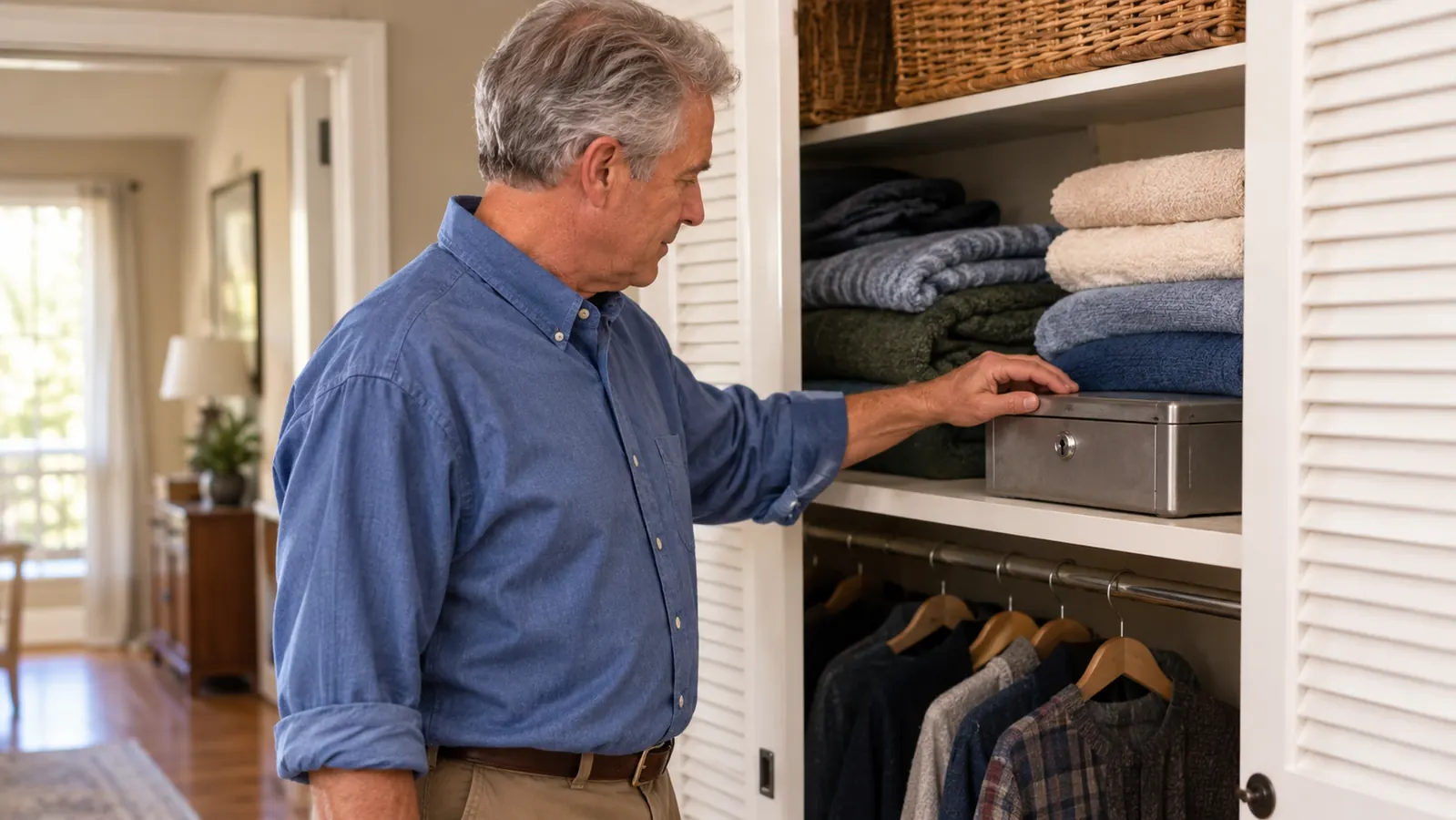
My first try was the top shelf, above the hanging rod, and it lasted one week. At seventy-one I could not read the keypad buttons without tipping my head back and holding a flashlight in my teeth, and Carol could not reach it at all without the step stool. We moved it down to the shelf at chest height and it has stayed there. If two people use the box, both of them should be able to work it standing flat on the floor.
In our closet the shelf runs 11 inches deep, and the safe sits with about three inches behind it so the hinge clears the wall. I put it at chest height rather than above my head, and that matters more at seventy-one than it did at fifty. If you have to stand on a step stool to work a keypad in a dim closet, you will stop using the safe. A safe you stop using is just a shelf.
Write the measurements on a strip of masking tape and stick it to the shelf before you drill anything. It sounds fussy. It is faster than drilling twice.
Step 2: Choose a Spot That Is Not the Bedroom Dresser
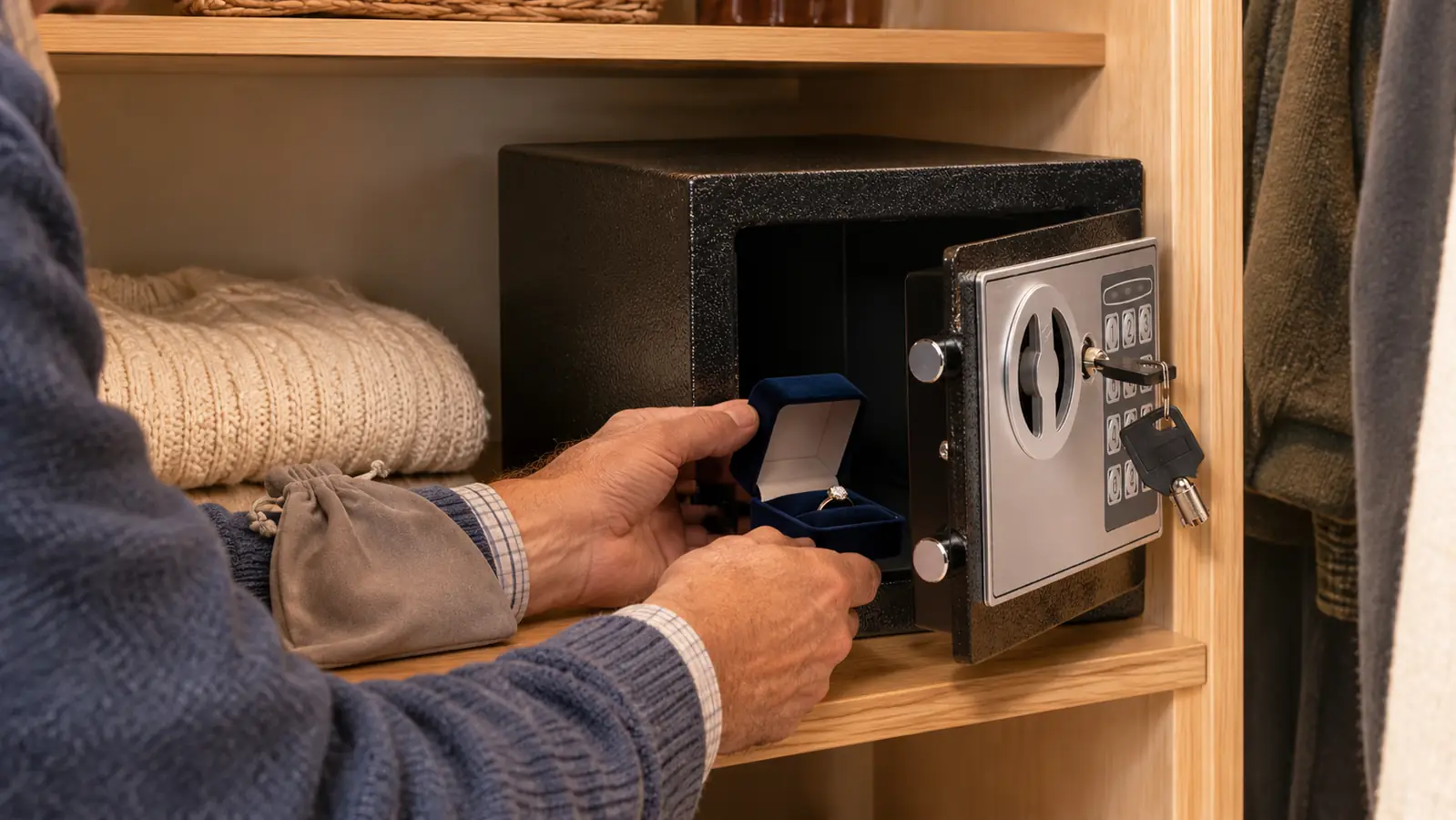
The master bedroom is the first room a burglar goes to and the dresser drawer is the first drawer he opens. I have written up enough claims to know that a locked drawer is a two-second delay, not an obstacle. The closet is better. A closet shelf with linens on it is better still, because the box does not announce itself when the door swings open.
Put it in the walk-in closet, on a shelf you actually use, behind the folded towels. Not on the floor, where a wet mop and a leaking water heater find it. Not in the bathroom either, because steam works its way into everything and this box has no gasket.
That last point deserves plain language. The listing rates this safe as not water resistant. Our basement took on water in a spring storm a few years back and I lost a box of paperbacks to it. A steel box sitting on a basement floor would have rusted from the bottom up. Keep it on the main floor of the house, above the lowest shelf, and away from any pipe run you can see.
Step 3: Bolt It Down Before You Put Anything In It
The listing calls this safe portable, and that is honest. It weighs 5.8 pounds. A man with a pry bar and a minute alone can carry it out of the house and open it at his leisure. Bolting it down is not optional if you genuinely care about the contents. It is the whole difference between a lock box and a safe.
I tried it the lazy way first. I set the box on the shelf, marked the holes and drove two drywall anchors into the shelf board because that was the bit already in the drill. Three weeks later the box shifted when I pulled the door open, and I could see the anchors had wallowed out the particle board. That is when I pulled the shelf, found the frame and did it the way I should have from the start. The second attempt took forty minutes and has not moved since.
The box arrives with pre-drilled holes, two expansion screws and mounting bolts, and it is built for wall or floor mounting. In our closet I drove the screws down through the bottom of the safe into the shelf frame, not just into the shelf board. Drywall anchors in a closet shelf hold nothing. Find the framing, mark it, and use the hardware that came in the box.
Do the drilling while the safe is empty. Close the door afterward, check that it latches, and confirm the keypad still sits flush against the door face. Take the screws back out, mount it for good, and only then start loading it. Loading first is how people crack a hinge or lose a screw down into the wall cavity.
Step 4: Set the Code Like It Matters
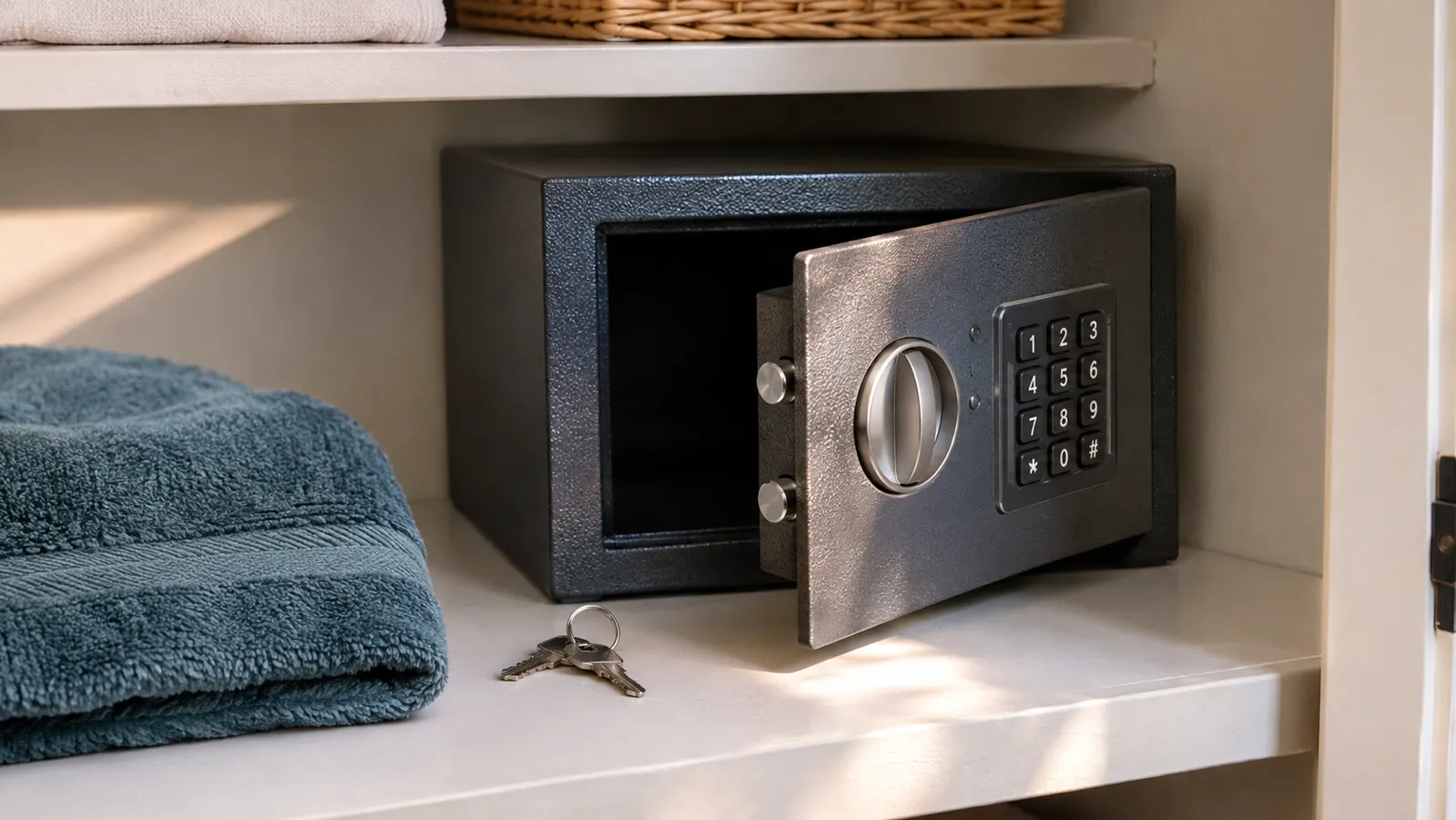
The keypad is a push button control, and the door has a magnetic latch that pulls it shut on its own, so the safe does not sit hanging open by accident. Choose a six digit code that is not a birthday, not an anniversary and not the last four digits of a phone number. I use a number I can only describe as unmemorable, and I have written it down nowhere in this house.
Two emergency keys come in the box. Do not keep both keys in the same building as the safe. One goes to our daughter over in Derby. The other lives in the lockbox in my truck, which is not a hiding place I would recommend for jewelry but is a fine place for a spare key. If both keys sit in the kitchen drawer, the keypad is decoration.
Test both keys before you close that door for the last time. Keypads fail. Batteries go dead, buttons get sticky, and the one that quits will be the one you were counting on at the worst possible hour. The keys are the reason an inexpensive electronic lock is acceptable at all. The listing also notes an anti-theft alarm, which is a decent second layer, though I would not build a plan around a buzzer.
Step 5: Make a Record and a Rotation Habit
Photograph every piece on a plain towel with a ruler laid in the frame. Write one line about each item. The cameo has a hairline crack in the shell. The pearl strand is knotted between beads. The watch case is not original. If you ever have to file a claim, that record is worth more than an appraisal, because it proves the piece existed and describes it the way an adjuster can use.
Do the photographing on the day you load the box, not later. The date stamp is the part an adjuster cares about, because it puts the piece in your hands before the loss instead of after. I did ours in October on the kitchen table with the north light coming in. Twenty-two pieces, one photo each, and the whole job took half an hour.
Then call your insurance agent. A safe does not insure anything. It reduces the chance of a loss. The scheduled rider on jewelry is what actually pays. Ask whether the pieces need an appraisal, ask what the deductible is, and ask whether the policy covers mysterious disappearance, because most homeowners policies do not.
Once a year, open the box. Take the jewelry out, wear one piece to church, check the rest for tarnish and stiffness, and swap the silica packet for a fresh one. That single habit does more for heirloom jewelry than any lock, because what ruins these pieces is usually slow and chemical, not fast and violent.
What Else Helps
Keep a silica packet in with the jewelry and change it every year. Pearls should not go into a sealed plastic bag, because they want a little moisture in the air around them. A soft cloth pouch inside the steel box is enough. Sterling silver will tarnish faster in a closed steel box than it would on a dresser, so give the silver its own tarnish-resistant pouch and keep the two apart.
Do not put everything in one container. Our deeds, passports and my father's coin collection sit in the bigger fire-rated safe bolted to the closet floor, because those need fire protection and this small box carries no fire rating on its listing. I will not pretend otherwise. The Yuanshikj safe is a burglary deterrent for small valuables, and by the look of 4.4 stars across 23,268 ratings, a lot of households use it for exactly that.
And tell one person. One adult child, one trusted neighbor, one person who knows the box exists, where it sits and who holds a key. A safe nobody knows about is a box that gets skipped in a house cleanout after a funeral. The point of keeping these things is that they get handed down, not that they stay hidden.
A 5.8-pound steel box on a closet shelf is a portable box. The same box through two screws into a shelf frame is something a man with a flashlight has to work at.
Measure the shelf tonight. Bolt the box this weekend. Then stop worrying about the shoebox.
The Yuanshikj small keypad safe holds a jewelry roll, two ring boxes and a folded document or two. It is 0.23 cubic feet of alloy steel with a push button keypad, two emergency keys and mounting hardware in the carton. What it needs from you is a stud, a drill and twenty quiet minutes.
Amazon See the Yuanshikj Safe on Amazon →