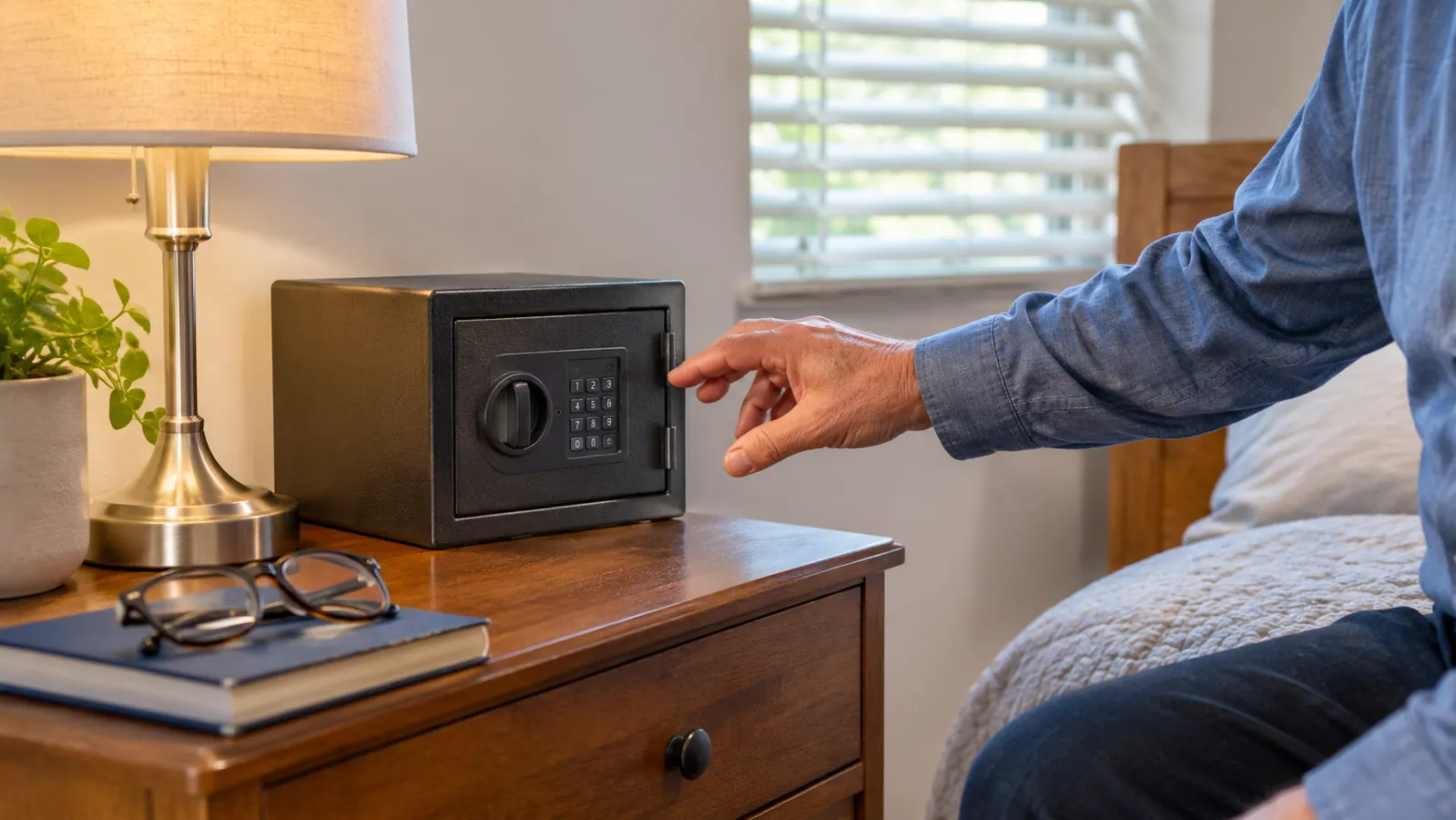
Most people keep the thing they want fastest in a dresser drawer. I know because I spent thirty-one years as a homeowner insurance adjuster walking into houses after fires, floods and break-ins, and the drawer was always the same. A pistol under a stack of t-shirts. A passport in a shoebox. A grandmother's ring in a coffee mug on the shelf. Nobody plans it that way. The drawer is just where the hand goes at bedtime.
A small safe at the bedside fixes that without turning your bedroom into a vault. The ONNAIS Iron PRO is a compact biometric and keypad safe built for exactly this spot, and I have kept one at the side of my bed for about a year now. Below are ten reasons it earns the space, in plain kitchen-table terms, and one honest reason you may want to buy something else first.
The drawer by your bed is not a lock
A fingerprint reader, a keypad code and a backup key, in a body that measures 9.17 inches wide and 3.07 inches tall. Small enough for the nightstand, steel enough to mean it.
Amazon See the ONNAIS Iron PRO on Amazon →It fits a nightstand drawer without a rebuild
The numbers are what matter here. The ONNAIS Iron PRO measures 9.17 inches wide, 3.07 inches tall and 2.91 inches deep. That is smaller than a hardback book standing on its side. It went into my nightstand drawer with room left for a flashlight and my reading glasses, and it does not foul the lamp cord behind it. If your nightstand has no drawer, it sits on a closet shelf just as easily.
Your hand finds it in the dark, one touch and it is open
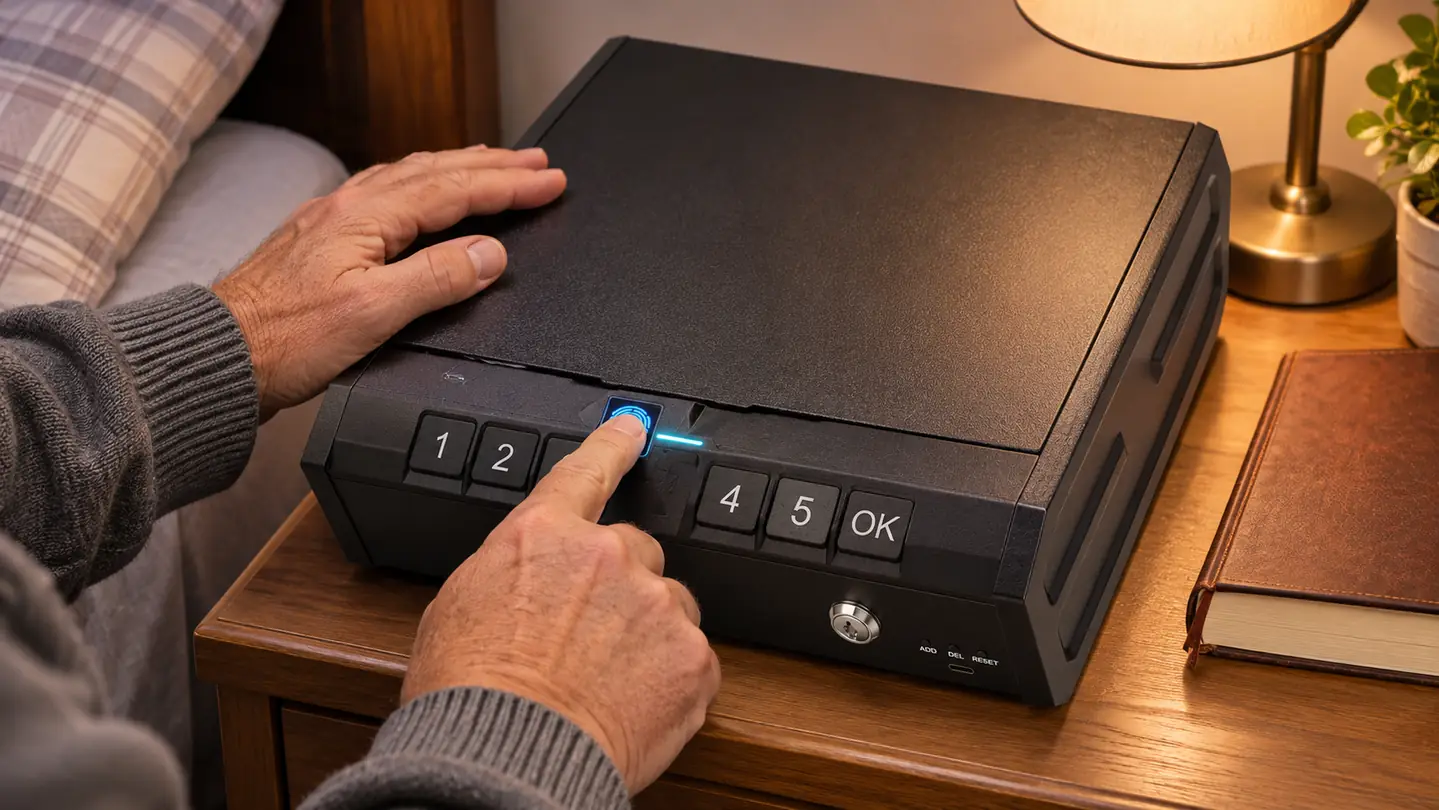
The whole point of a bedside safe is the middle of the night. A keypad in the dark means counting buttons. A key means finding a key. The fingerprint reader is the fast path: you enroll your print once, and after that a single touch on the reader releases the lock. I have opened mine at two in the morning without turning on a light and without my glasses on. That is the only test that counts.
The keypad covers you when your hands will not cooperate
Fingerprint readers are good, not perfect. A cold Kansas morning, a little hand lotion, a bandage on your thumb, and the print will not read. That is when the keypad on the ONNAIS safe earns its place. You set a code, and the code works whether your hands are dry, damp or shaking. I set mine to something I could punch with my eyes closed. If arthritis has settled into your fingers, a code you can enter by feel beats a small key every time.
A backup key means a dead battery is not a locked door
Every electronic lock runs out of battery eventually, and it will pick a bad week to do it. This safe includes a backup key, and the key does not care about batteries. Mine lives somewhere other than the nightstand, which is the whole trick. A backup key taped to the back of the safe is not a backup key. It is a key for whoever broke in.
External power gets you in when the key is missing too
Here is the part most bedside boxes skip. If the battery dies and you cannot put your hands on the key, you can connect a power source to the safe and open it with your fingerprint or your code. That is the difference between a nuisance and a locksmith bill on a Sunday. I have never needed it. I like knowing it is there, the same way I like knowing where the water shutoff is.
Alloy steel body, not a plastic case with a lock glued on
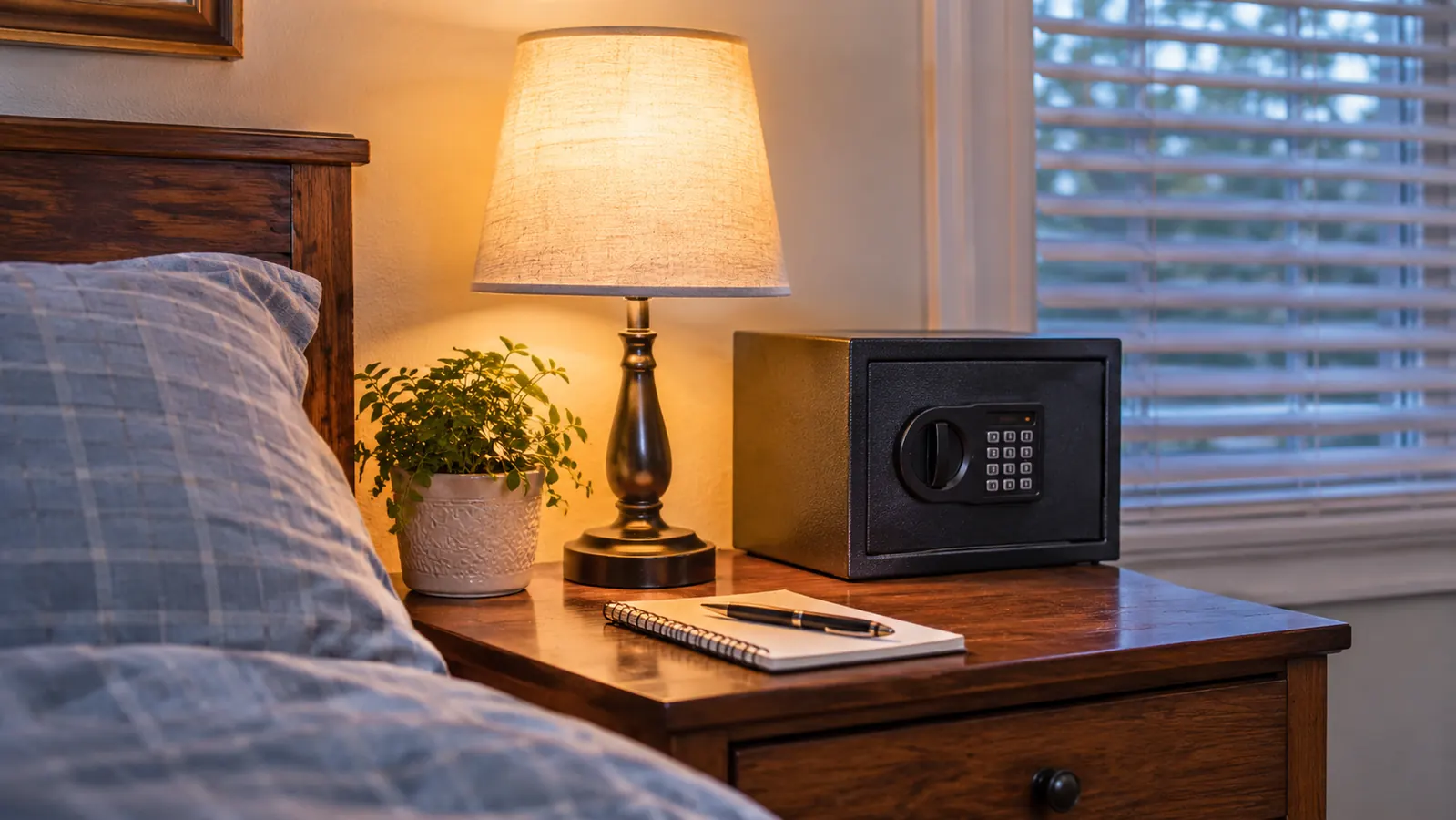
The body is alloy steel, and the listing describes the construction as anti-theft. That matters, because the cheap version of this idea is a plastic box with a luggage-style latch. A plastic box is a place to put something, not a place to keep it. Steel does not make anything unbeatable and I will not pretend otherwise. It does mean a person cannot pry it open with a butter knife and thirty seconds of patience.
It can be mounted, so it does not walk off
The mounting type on this safe is wall mount, and that matters more than it sounds. If your nightstand is the kind that tips, or you have grandchildren who treat furniture like playground equipment, a mounted safe removes a whole category of worry. Mine sits in the drawer, but a wall mount above the nightstand or inside the closet shelf is a reasonable way to go. Ten minutes with a drill, and it stays where you put it.
The grandchildren cannot open it, and you never have to say a word
I have four grandchildren, ages six to fourteen, and they are in this house most months. The reader holds the prints you enroll, so a child cannot guess it the way a child can guess a four-digit code written on a notepad. The handgun goes in the same place every night and comes out the same way. I do not have to give a lecture about the closet, and I do not have to move anything when they visit. That alone was worth the shelf space.
One place to check before a storm, a trip or a hospital night
Habit is what protects things, not hardware. Mine is a walk through the house before we leave: stove off, doors locked, hand on the safe. Passports, the spare cash, the coin that was my father's, all of it in one spot I can name out loud. When Carol and I drove to our daughter's place in Missouri last spring, I did not have to think about where anything was. That is a small thing until the afternoon you need a document in a hurry.
It ends the first hour of a bad night
In my line of work you learn that the first hour after a break-in gets spent searching, not securing. People tear through drawers looking for a passport, a deed, a policy number, a gun they are not certain is loaded. A bedside safe with a fingerprint reader gives you one drawer you can open and know. That is the whole case for it. Not that it makes you safe from everything, but that it removes the worst twenty minutes.
What I'd Skip
If what you are protecting is a stack of papers, skip this and buy the closet safe first. Deeds, wills, birth certificates, Carol's mother's jewelry, the coin collection, backup drives of family photos. This unit is sized for a handgun at the bedside and it is honest about that. I keep a heavier bolted safe in the walk-in closet for the documents, and I bought that one before this one. The second thing I would skip is expecting the fingerprint reader to suit everyone in the house. Enroll a second print, set a code for the person who refuses to bother, and keep the key somewhere sensible but not obvious. And if you are not willing to place it where it actually lives, do not buy it. A safe under a coat in the closet is a safe nobody opens, and a safe nobody opens is a heavy box.
I have opened mine at two in the morning without turning on a light and without my glasses on. That is the only test that counts.
Ten reasons, one honest caveat, one drawer
If the bedside is where the thing you want fastest actually lives, this is the safe sized for it. Fingerprint, keypad, backup key and external power, all in a body that fits a nightstand drawer.
Amazon See today's price on the ONNAIS Iron PRO →