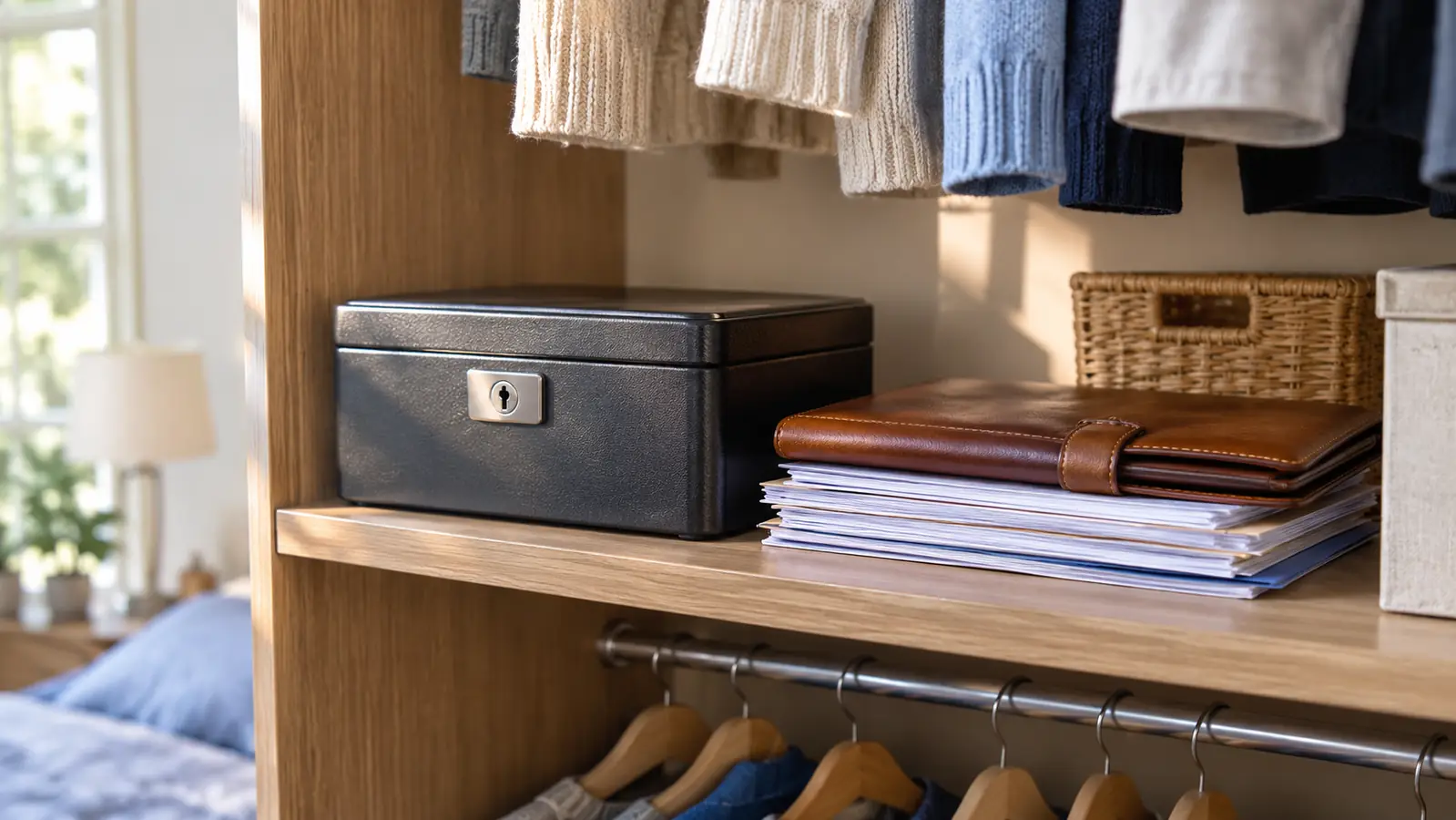
A keypad-only handgun lockbox and the ONNAIS Iron PRO look like the same purchase on the shelf. Both are metal boxes with a lock and a lid. The difference shows up at 2 a.m., with the lights off and your glasses on the nightstand. One asks you to find four or six numbers by feel. The other asks for a finger, and it keeps a keypad and a backup key behind that finger in case the electronics have a bad night.
I spent 31 years as a homeowner insurance claims adjuster, walking through houses after fires, floods and break-ins, and the lesson I brought home was never about which box had the better brochure. It was about whether the owner could open the thing under pressure. I keep the ONNAIS Iron PRO mounted at my bedside for the handgun I do not want the grandchildren finding. Carol keeps a small keypad-only safe on her dresser for her mother's jewelry. I have used both kinds of lock in this house, on ordinary mornings and on one bad night. Here is the short answer before the long one. If the box holds a gun you might need in a hurry and more than one adult has to be able to open it, the Iron PRO earns its place. If the box lives in a drawer you open twice a year, one adult uses it, and you want the simplest lock in the house, a keypad-only box does the job and asks less of you. The table below is how I would lay it out for a neighbor at the kitchen table.
| ONNAIS Iron PRO | Keypad-only lockbox | |
|---|---|---|
| Ways in | Fingerprint reader, keypad code, and a backup key | A code, and on most models a key |
| Opening in the dark | One finger on the reader, no numbers to find | Four to six presses by feel, and a miss starts over |
| Dead battery | Backup key, plus an external power connection for the fingerprint or the code | Key only, and some models put the keyhole underneath |
| Dry, cracked fingertips | A worn print can take two or three tries | The code works the same in January as in July |
| Things that can fail | Reader, keypad, battery and key cylinder | Keypad, battery and key cylinder |
| More than one adult | Each person enrolls a finger, no code to share or forget | One shared code, changed after every visit from the grandkids |
| Mounting | Has a wall-mount provision and I used it | Often sits loose in a drawer unless you drill it yourself |
| What fits inside | Interior measures 9.17 inches wide, 3.07 inches high and 2.91 inches deep, so measure your pistol and holster | Varies by model, so measure before you buy |
| Upfront cost | The higher of the two | The lower of the two |
Where the ONNAIS Iron PRO Wins
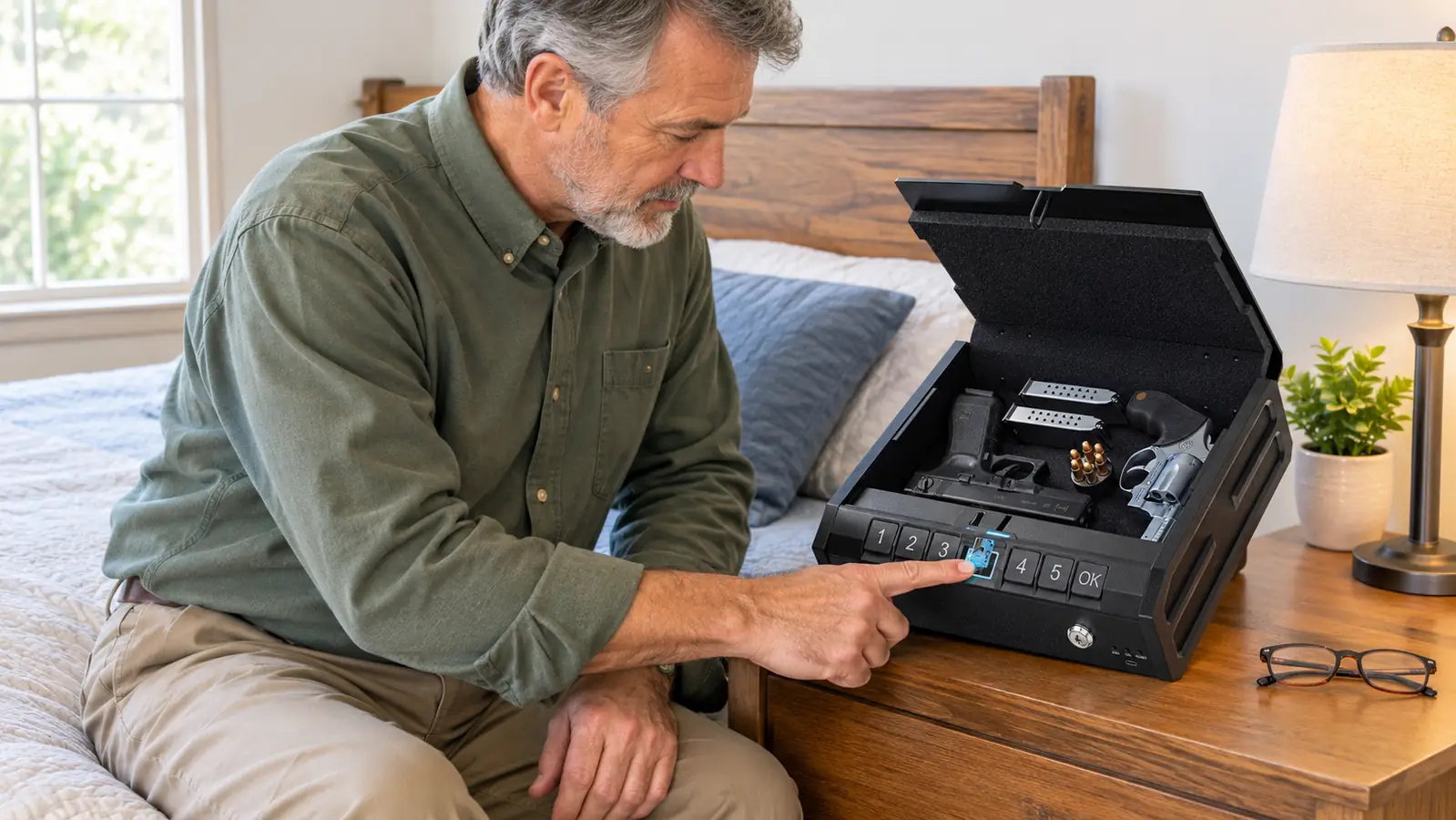
Three ways in is the entire argument. The Iron PRO takes a fingerprint on a high-resolution reader, a code on the keypad, and a physical key. The listing also spells out the part most people skip: if the battery dies and the key is not where it should be, you can connect an external power source and open it with your fingerprint or your code. I have opened enough dead-battery electronics to know that is not a marketing line. It is the difference between a five-minute annoyance and a locksmith bill, and the locksmith bill usually arrives on a Sunday.
The other thing I care about at 71 is that I do not have to read anything. My eyes are fine in daylight and useless at 3 a.m. A keypad is a good thing to have, but you still have to find the right four numbers in the right order with a hand that has just woken up. A finger on a reader is one motion. When my hand is on the lid, the lid is opening. That is the whole test for a bedside box, and the Iron PRO passes it more often than the keypad box on Carol's dresser.
The test I ran was not scientific. I put both boxes on the kitchen table on a Saturday afternoon, set the Iron PRO's code and enrolled my right thumb and my left, then had Carol time me opening each one from a dead stop with my eyes shut. I did it ten times each. I will not pretend I was fast on either. What I noticed was the shape of the mistakes. On the keypad I pressed a number twice and had to stop and start over, which meant lifting my hand and finding the buttons again. On the reader I missed once, adjusted my thumb, and the second press took. A miss on a reader costs you a second. A miss on a keypad costs you the whole sequence.
Measure the inside before you order, and measure with the pistol in your hand, not from memory. The interior on this one runs 9.17 inches wide, 3.07 inches high and 2.91 inches deep, which is a narrow, shallow box. A full-size pistol with a light hanging off the rail will not sit the way the pictures suggest. Mine fits with the magazine out and the slide forward, and I laid a folded cloth under it so the finish does not wear against the steel floor. The alloy steel body is the reason it weighs what it weighs, and the weight is the reason it stays where you put it once it is screwed down.
It mounts, and that matters more than people think. The box has a wall-mount provision and I used it, screwing mine to the inside of the nightstand frame so it cannot be carried off in a hurry. A lockbox that sits loose in a drawer is a lockbox a visitor can pick up and walk out with, contents included. Mounting takes ten minutes with a drill and a level head, and it is the step most people skip. Skip it and you have bought a heavy lunchbox.
Each adult enrolls a finger. Carol's print is enrolled and so is mine, and neither of us has to remember a number or write one on the back of an envelope. Codes get shared, then forgotten, then written down somewhere foolish. A finger is harder to leave on a sticky note in the junk drawer. Change the code on a keypad box and you owe everyone a phone call. Change a fingerprint and the conversation is over before it starts.
Where the Keypad-Only Lockbox Wins
Now the honest part, because a comparison that gives one side every row is a sales sheet, not a comparison. My fingers in January are dry enough to catch on flannel. A fingerprint reader wants a decent print, and a cracked thumb in a Kansas winter can take two or three tries before it reads. The keypad box does not care about the weather. Four presses, lid open, done. If your hands are dry, arthritic or scarred from a lifetime of work, that is not a small advantage, and you should test your own finger on any biometric box before you trust it with something you need in a hurry.
Carol's box sits on her dresser and holds her mother's jewelry, and she opens it maybe twice a month. She has never once complained about the code. I asked her in February, when the air in this house is dry enough to spark on a doorknob, whether she would trade it for a fingerprint box. She said no, and she said it fast. Her hands ache in the cold and she does not want to argue with a reader at seven in the morning. That is the whole case for the keypad, and it is a good case. A lock you can work with cold hands on a bad day is a better lock than a fancier one you avoid touching.
Fewer parts means fewer things to fail. The keypad box in this house has a keypad, a battery and a key cylinder. The Iron PRO adds a reader to that list, and a reader is a surface that collects dust, lint and thumb grease. It wants a wipe now and then. Nothing about that is difficult, but it is one more piece of upkeep on a device you may not touch for months. A box that sits untouched for half a year is exactly the box whose reader gets fussy right when you need it.
Portability cuts both ways and I will say so plainly. A keypad-only box slides into a suitcase or a glove compartment, and it can move from the closet to the truck without a drill and a Saturday. That same lightness is why I would not leave one loose on a nightstand with a handgun inside. If you want a box that travels, the keypad model is the one that travels. If you want a box that stays put at home, bolt whichever one you buy and be done with it.
Three ways in beats one way in, but only if one of those ways is a way your hands can manage on a bad morning.
Three ways in, bolted where the grandkids cannot reach
The ONNAIS Iron PRO gives you a fingerprint, a code and a backup key, plus an external power connection for the day the battery quits. Check the current price and the interior dimensions before you commit, then mount it the same week it arrives.
Amazon Check Today's Price on Amazon →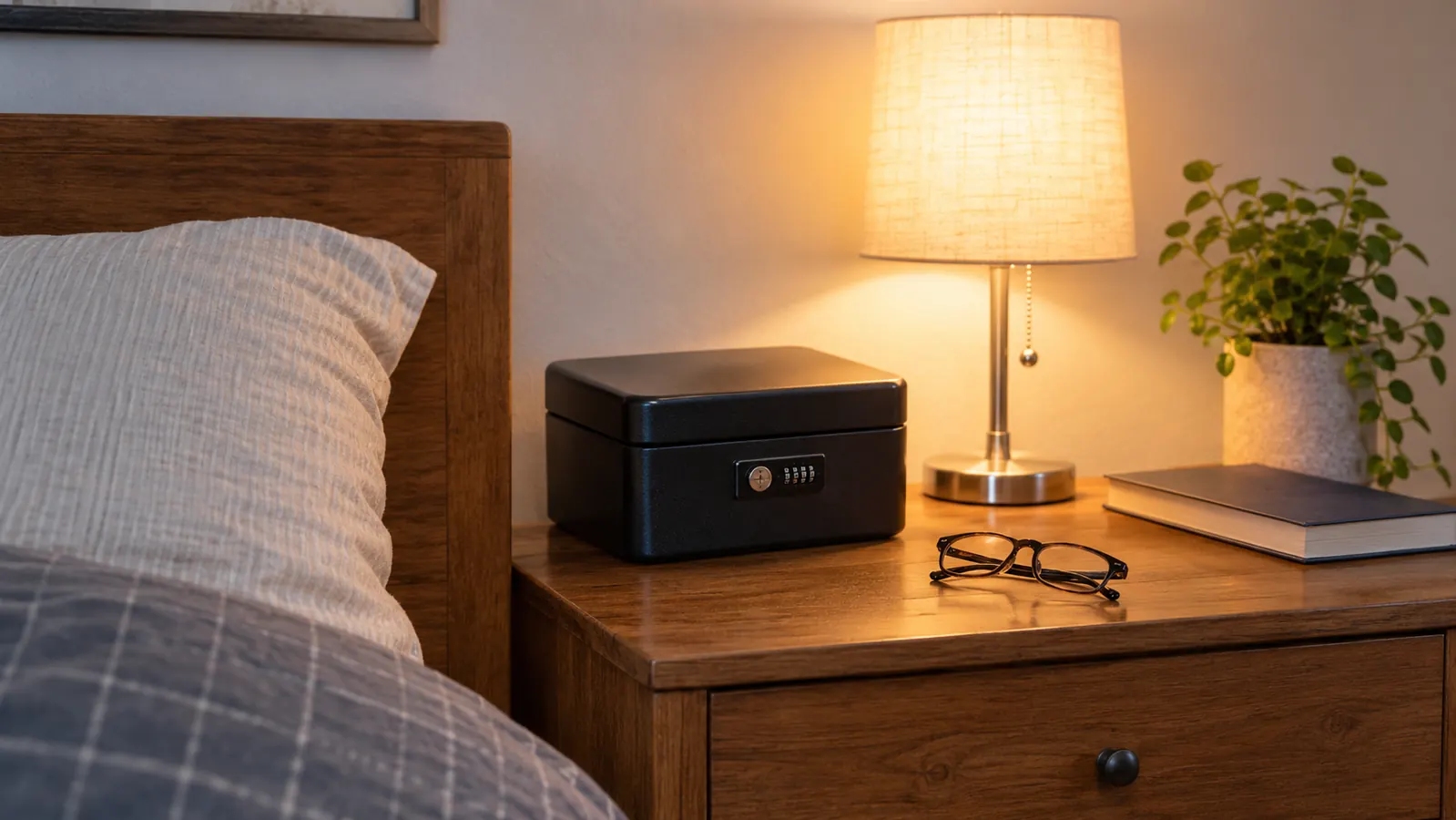
Who Should Buy Which
Buy the ONNAIS Iron PRO if the box is going at your bedside and it holds a gun you might actually need in the dark. Buy it if two adults in the house have to be able to open it without a conversation about who changed the code. Buy it if you are willing to spend ten minutes with a drill, because this box is at its best bolted down. And buy it if you accept the trade: a reader that can be fussy on a dry morning, in exchange for a lid that opens on one motion the rest of the year.
Buy the keypad-only box if one adult uses it, if it lives in a drawer you open when the tax papers come out, or if the whole point is that there is nothing to learn. Buy it if your hands are the reason you are reading this, because a code does not care about cracked skin. Buy it if the box has to travel. And buy it if the box is a second one, a decoy in the sock drawer while the real valuables live somewhere heavier. There is nothing wrong with that plan. I have recommended it to neighbors for years.
Here is how I would split it if you are still on the fence. Count the people who need in. If the number is one, and that person is you, and the box is not at your bedside, buy the keypad. If the number is two or more, or the box is at your bedside, buy the Iron PRO. Then count the times a year you expect to open it. Twice a year is a drawer box. Twice a week is a box that has to work without you thinking about it, and that is a different purchase. I have watched people buy the more capable box for a drawer and the cheaper box for the nightstand, and both of them got it backwards.
Buy neither if what you are protecting is paper. A deed, a passport, a will and a coin collection that belonged to your father need a fire-rated safe bolted to the floor, with the documents inside a sealed bag. A compact lockbox is for a handgun you want close, not for the things you would grieve over after a house fire. I have walked through the aftermath of those fires, and the people who lost the least were the ones who had already separated the two jobs. One box for quick access. One safe for the irreplaceable.
Whatever you choose, do three things. Mount it. Practice opening it once a month, in the dark, with your eyes closed, until your hand knows the way. And keep the backup key somewhere a child cannot reach and you can, because the one night the electronics sulk is not the night to start searching the junk drawer. That advice costs nothing and it is worth more than the difference between these two boxes. I would add a fourth. Write the code down once, seal it in an envelope, and put the envelope in the heavier safe with the deeds. Not in the junk drawer, not taped under the lid, not on a sticky note. If you cannot remember a four-digit number, let the paper remember it and let the heavier safe guard the paper.
The one I keep mounted at my bedside
Fingerprint, keypad, backup key, and an external power connection for a dead battery. If your hands are dry and stiff, order it, bolt it down, and enroll your finger on a good day, not the worst one.
Amazon Check Today's Price on Amazon →