
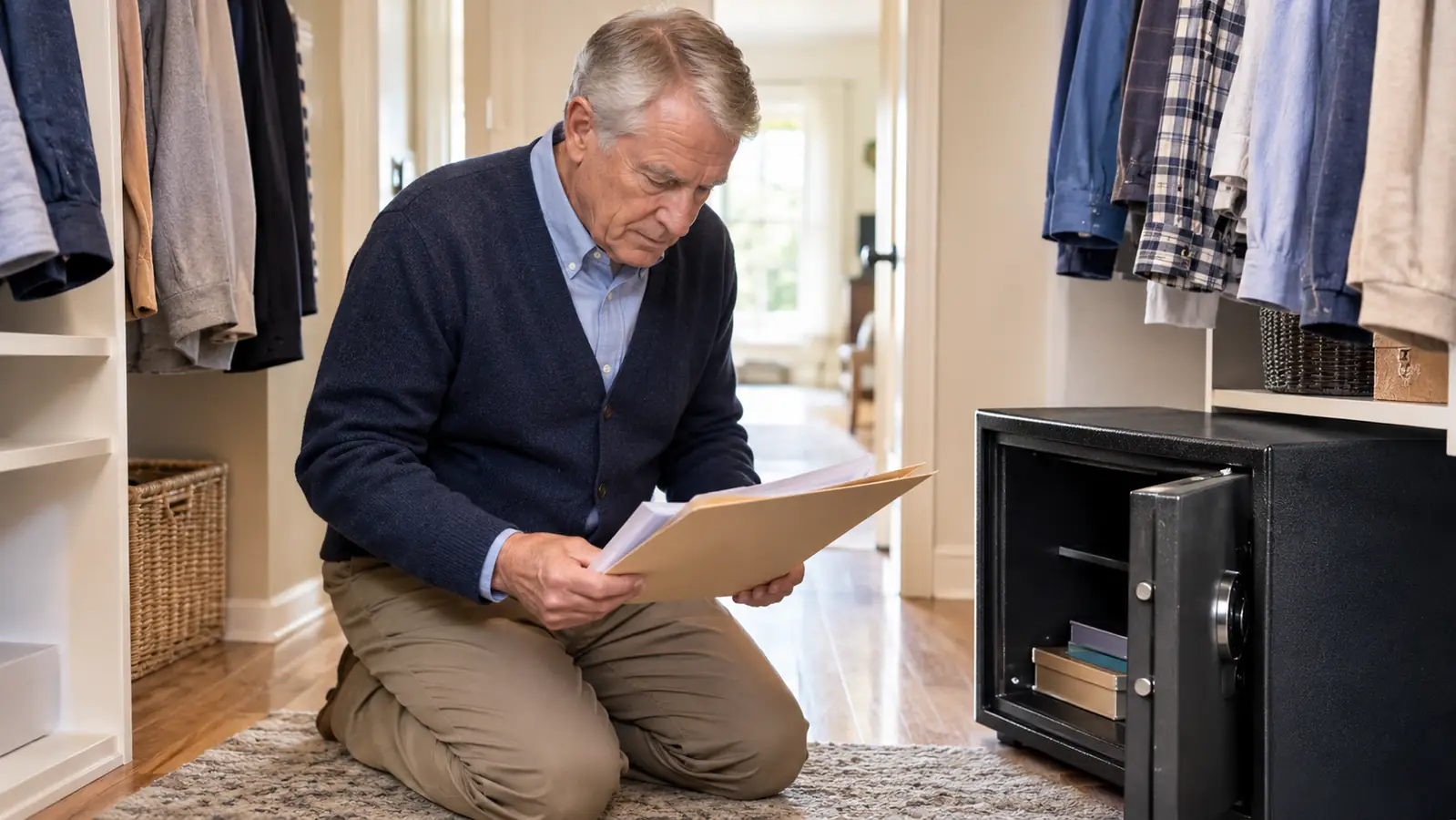
I spent thirty-one years as a homeowner insurance claims adjuster, and the worst conversations happened at kitchen tables in houses that still smelled like wet charcoal. Somebody would look at me and say the papers were in the desk drawer. The deed. The will. The passports. Thirty years of tax records in a cardboard box under the bed. I wrote it all down, because that was my job, and then I drove home thinking about how little it would have cost them to avoid that sentence entirely.
That is why I own a SentrySafe STW123GDC. Not because I like gadgets, and not because a sales page talked me into it. It sits on the floor of my walk-in closet, bolted down, and it has been there about eighteen months. What follows is the review I would have wanted before I ordered, including the parts the listing does not say out loud and the parts I had to learn with a tape measure and a sore back.
The Quick Verdict
A real one-hour fire rating and a verified water claim in a 1.23 cubic foot box, held back by 90 pounds of weight, an 8 inch wide interior, and a one-year warranty that feels thin for something meant to outlive the mortgage.
Amazon Check Today's Price →The rating I wanted on my own closet floor
UL Classified for one hour at 1700 degrees Fahrenheit. ETL Verified for 24 hours in water up to 8 inches deep. Check today's price and the current dimensions before you commit to the weight.
Amazon Check Today's Price on Amazon →How I've Used It
Eighteen months ago the SentrySafe arrived on a pallet at the end of my driveway on a Tuesday afternoon in April, and that is the first thing nobody mentions. The freight driver would not bring it up the drive, which is fair enough, so the pallet sat there while I cut the strapping in the garage and slid the carton inside. Ninety pounds is a two-person object, and I am seventy-one with a back that has opinions. I tried to walk it four feet on my own and set it back down. Then I called the neighbor's boy. We laid cardboard down the hallway to protect the hardwood, tipped the box onto a hand truck, and rolled it through the garage, along the hall, and into the walk-in closet. No stairs, thankfully. If you have stairs, line up your two people before the truck shows up, not after, and do not let a driver talk you into a curb drop.
The listing calls the mounting type floor mount, and I took that seriously. It is bolted through the closet floor now, four bolts into solid framing with a washer at each head. A ninety pound box that is not fastened down is a box two men can carry out of your house in under a minute, and I have written up that exact loss more times than I care to count. Bolted, it is furniture. It does not tip when somebody pulls the open door, and it does not walk. The drilling itself took a Saturday morning and one trip to the hardware store for a bit I did not own. I checked twice for anything running under that floor before the first hole. You should check three times.
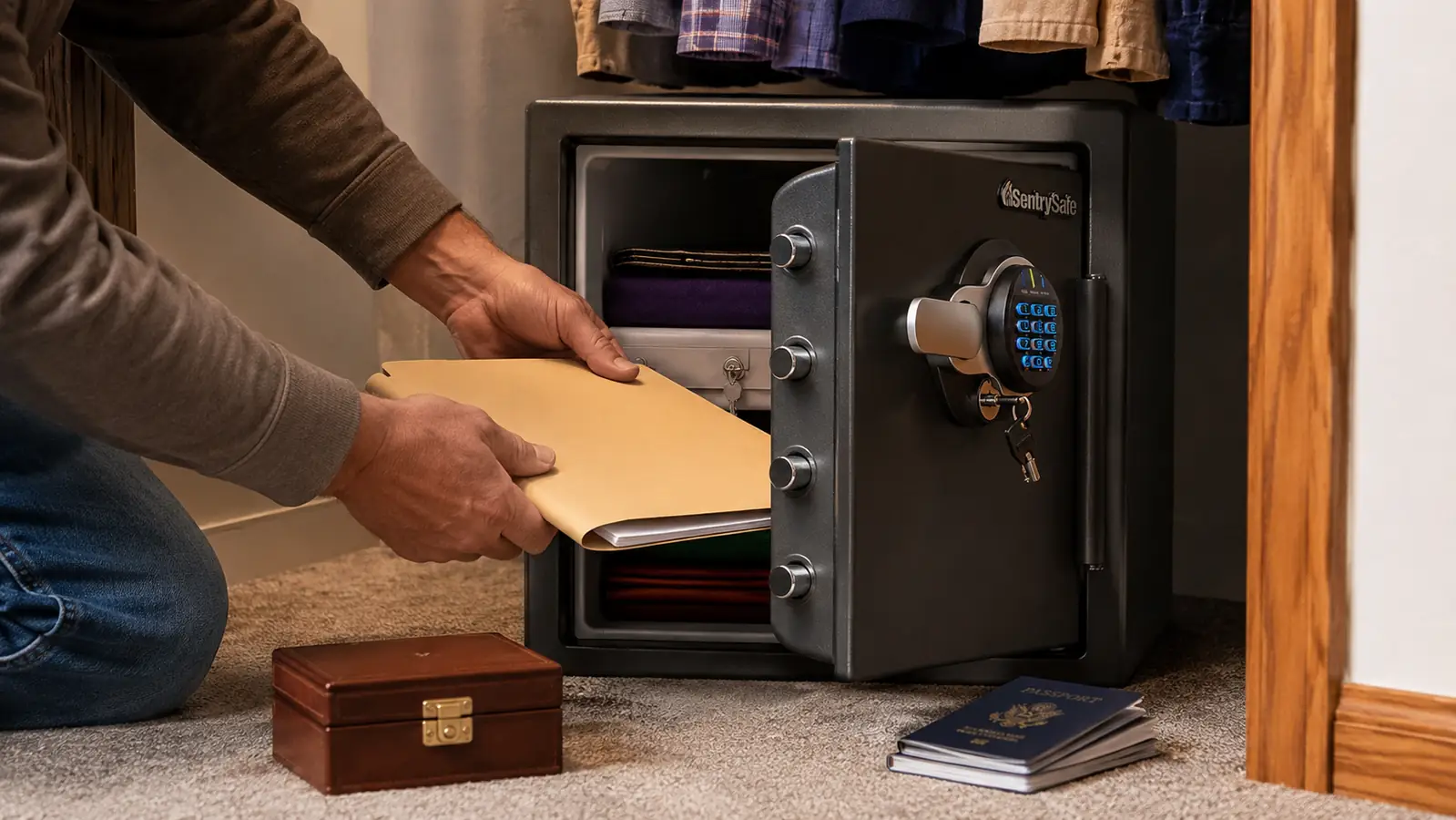
Inside: the deed and the title work in one folder, passports and birth certificates in another, the wills, my father's coin collection in its album, Carol's mother's jewelry in a small lockbox that sits inside the bigger one, some emergency cash, and the backup drives of the family photographs. Not the handgun. That lives in a bedside box built for the purpose, because a closet safe this tall and this narrow is the wrong shape and the wrong distance from where I want it at two in the morning. The coin album is the thing that surprises people. It is not worth a fortune and it never was, but it belonged to my father and there is no replacing it at any figure I could name.
Eighteen months in, I open it maybe twice a month, and that is the honest pace of the thing. It is not a product you interact with. It is a product you forget about until the day you need it, which is the entire job description. I set my own combination on a Sunday afternoon with the door propped open, following the sheet that came with it, then wrote the number on the inside of a kitchen cabinet door where only Carol and I would think to look. I have not thought about it since. The secondary key went into a fire box at my daughter's house, which she finds mildly annoying and I find correct.
What Nobody Tells You About the One-Hour Rating
The box is UL Classified to endure one hour at 1700 degrees Fahrenheit. In kitchen-table terms, a testing lab put it in a furnace at that temperature for a full hour and then checked whether the paper inside was still readable. The classification is about the contents, not the container. The steel will be discolored and the paint will be gone. That is not the question anybody cares about. The question is whether the deed still has legible print on it.
Here is the part that gets left off most product pages. One hour is a test condition, not a schedule. I have stood in the aftermath of fires that ran all night. One was a farmhouse out in Sedgwick County where the kitchen started it, and by the time the trucks had water on it the roof was gone and the interior was still cooking. That family lost the papers and the photographs and every bit of it, and none of it was anybody's fault. A house fire in the county can burn well past sixty minutes before anyone puts water on it, and if the room the safe sits in is involved for three hours, you have bought one hour of protection and spent the other two hoping. Buy the rating for the time it buys you, and understand that the fire department's response time is the other half of the equation.
The second thing: that rating is written around paper. Photographs, negatives and hard drives have their own limits, and a drive that has been cooked is a drive that is gone. I put the backup drives in a media bag inside the safe and I still keep a second copy at my daughter's house in Kansas City. One box in one closet is one failure point, and I did not spend thirty-one years documenting single points of failure in other people's houses to build one in my own hallway. If your photographs exist in exactly one place, fix that before you buy anything at all.
The Interior Is Taller Than It Is Wide
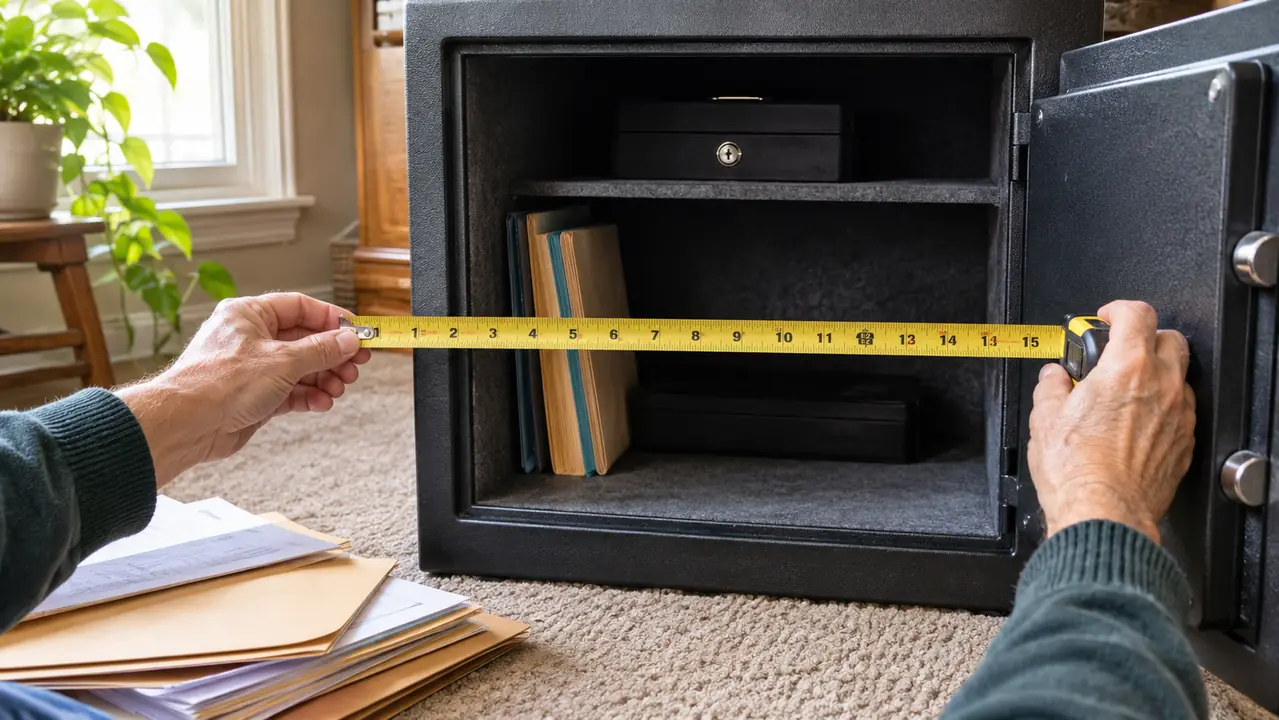
Read the chamber measurements before you order. The interior is 8 inches wide, 11.9 inches deep, and 13.8 inches high. The outside of the box is 16.3 inches wide, 19.3 inches deep, and 17.8 inches high. The 1.23 cubic feet is honest, but it is a tall, deep, narrow space, not a footlocker. If you are picturing a shelf of shoeboxes, picture a column instead. Before this safe I used a plastic storage tub with a lid, and before that a cardboard file box. Neither was a bad decision so much as a decision I never actually made out loud. The tub held more paper than the safe does. It also would have melted into a puddle on that closet floor, which is the whole difference between storage and protection.
A standard letter folder with a tab is about 11 inches long, and it lies flat in an 11.9 inch deep chamber with a little room to spare. Legal size does not. Fourteen inch folders have to stand up, and standing up they eat the height in a hurry. I measured the deed folder at the kitchen table before I ordered, felt faintly ridiculous doing it, and have not regretted the ten minutes. The closet doorway measured twenty-four inches clear, which mattered more than the safe's own dimensions, because a box that will not fit through the door is a box that lives in the garage forever.
The width is the number that surprised me. Eight inches means one stack across, not two. My folders go in one row, the lockbox sits on top of the row at the back, and the media bag goes in front where I can reach it. That is the whole organizational system and I worked it out over two evenings. On the first evening I tried to fit both the deed folder and the old tax records in the front, and the door would not close on the second try, so the tax records came back out and went to my daughter's fire box instead. The safe is a box. The order inside it is your job, and the box will not do it for you.
Weight, Bolting, and the Closet Floor
Ninety pounds empty decides everything about where this goes. It is not going on a shelf, it is not going upstairs without a plan, and it is not a thing you move twice. Mine sits on the floor of a walk-in closet, which means I gave up roughly a square foot and a half of floor and most of that closet's lower corner. Carol has mentioned this. Twice. The shoes that used to live there now live on a rack in the garage, and I have been told the arrangement is temporary, which is what she said in April of last year.
Fastening it down depends on what is under your floor. My house is a single-story brick ranch and that closet sits over a wood subfloor, so I bolted into solid framing and used a washer at each bolt head. If you are over a slab, you will want a masonry bit, a hammer drill, and patience. Either way, leave room to swing the door and room to kneel, because you will be kneeling in front of it, and at my age the kneeling is the part I notice. The door opens toward the closet wall and stops just short of it. I checked that with the tape before the drill came out, because a safe you have to open sideways in a closet is a safe you will quietly stop using.
The one thing I would not do is set it on deep carpet and call it mounted. Carpet hides a bad surface and lets the box rock. Mine sits on the subfloor with the carpet trimmed back around it, and the door still lines up the way it did the afternoon we set it down. If you are bolting into a floor over a finished ceiling below, get somebody who knows what is behind the drywall to look before you drill. That is not caution talking. That is thirty-one years of watching people discover a pipe the expensive way.
Water, the Keypad, and the One-Year Warranty
The box is ETL Verified for 24 hours of protection in water up to 8 inches deep. My basement took on water one spring when the sump pump quit, and I have seen what a soaked cardboard box does to a birth certificate. Eight inches and twenty-four hours are the tested numbers. Water standing above the door line, or a box that tips face down in a flood and sits that way, is outside what the verification covers. Put it somewhere that drains. Mine is in a closet on a floor that sits above grade, and I checked that grade with a level before the safe went in, which is the least romantic sentence in this review and possibly the most useful.
The lock is an electronic combination that you set yourself, with a secondary locking key, and the listing also notes an anti-theft alarm. I have not tested the alarm and I hope to keep it that way. On the keypad: any electronic lock is a battery waiting to disappoint you. When yours finally goes, the key is the whole plan. Keep that key somewhere other than the closet, or you have built yourself a very heavy filing cabinet with no handle. I also would not hand the combination to a house sitter. Give them the key and keep the number where it belongs, which is in your head and one other place.
The warranty on the SentrySafe is a limited one year. For a steel box that is supposed to outlast the mortgage, that is thin, and I will not dress it up. It did not change my decision, because the fire and water ratings are the product and the warranty is paperwork, but you should know what you are getting before you read the word limited and assume something longer. Then register the thing when the card comes in the box. A one-year warranty you never registered is a warranty you do not have.
What I Liked
- UL Classified for one hour at 1700 degrees Fahrenheit, which is a lab result and not a marketing adjective
- ETL Verified for 24 hours in water up to 8 inches deep
- 1.23 cubic feet holds letter folders, passports, jewelry, cash and backup drives in one place
- 90 pounds of alloy steel makes it a two-man carry for anyone who is not invited
- Built for floor mounting, so it can be fastened down and stop being portable
- Secondary locking key gets you in when the keypad battery quits
Where It Falls Short
- 90 pounds empty means a hand truck, two people, and a plan before it ever gets to the closet
- The 8 inch wide interior takes one stack across, not two
- Legal-size folders will not lie flat in an 11.9 inch deep chamber
- Limited one-year warranty on a product meant to last decades
- The keypad lives on a battery, and the key is your only backup
- Organizing the single tall chamber is entirely on you
Ninety pounds empty. That number decides where the safe lives long before the fire rating ever gets a say.
Who This Is For
This is for the homeowner in their fifties or older who has one household's worth of paper and one closet floor to spare. Deeds, titles, wills, passports, birth certificates, insurance declarations, the jewelry your mother-in-law left you, some cash, and the drives. If you can fasten it down, if you can live with a tall narrow interior, and if you want a fire rating a testing lab signed off on, the SentrySafe STW123GDC does the job without drama. It also suits the person who has been meaning to do this for six years and keeps not doing it. I was that person, and the only thing that finally moved me was a tape measure and a Tuesday with nothing else on the calendar.
Who Should Skip It
Skip it if you rent and move every couple of years, because you will be patching bolt holes and carrying ninety pounds up a stairwell. Skip it if your paperwork is legal size and has to lie flat, or if you need to store a long gun, because the interior is 13.8 inches high and that ends that conversation. Skip it if all you want is a light box under the bed for a passport and some cash, since a smaller safe does that fine and costs you nothing in floor space. And skip it if you are not going to fasten it down. An unfastened ninety pound box is a gift with a handle on it, and I have written up that gift more than once.
Measure your folders, then measure your closet floor
One hour at 1700 degrees. Twenty-four hours in 8 inches of water. 1.23 cubic feet of tall, narrow interior and 90 pounds that want to be bolted down. Check today's price when you are ready to give up the floor space.
Amazon Check Today's Price on Amazon →