
The first total-loss fire I ever worked, the family kept its important papers in a shoebox on the top shelf of a hall closet. The shoebox came through the burn without a scorch on it. The birth certificates inside were brittle brown and unreadable. That was more than thirty years ago and I still look at where a person keeps their deed before I look at anything else in the house.
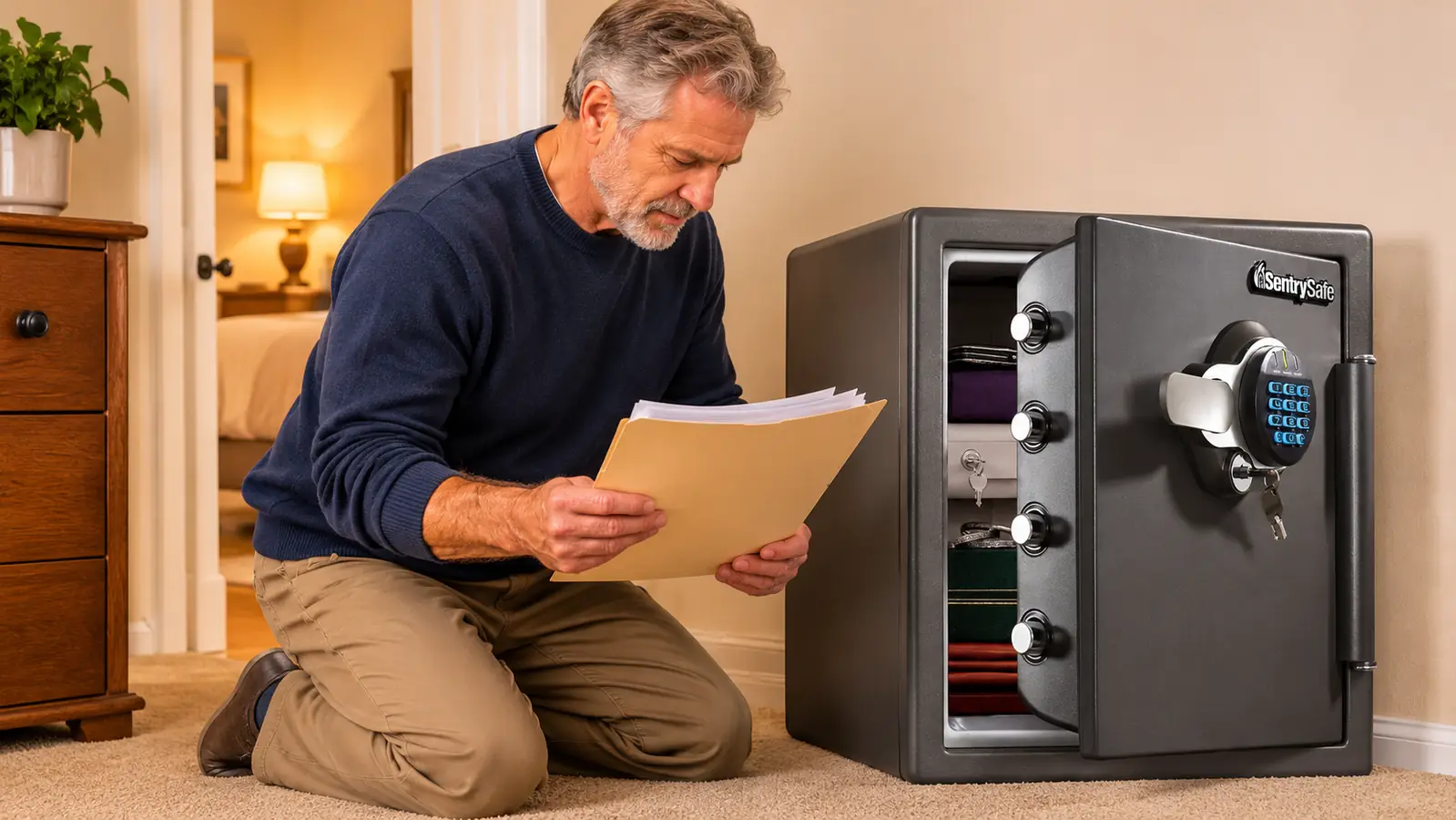
A steel box is not a magic trick. I spent 31 years as a homeowner insurance claims adjuster, and I have watched two men carry a 90-pound safe out of a house in less time than it takes to make a pot of coffee. What a safe actually buys is time and a temperature ceiling, and until the night you need those two things, it is hard to believe they are worth much. About eighteen months ago I bought the SentrySafe STW123GDC, the 1.2 cubic foot model with the digital keypad, and bolted it to the floor of the walk-in closet. This is what living with it has been like, including the parts I do not love.
The Quick Verdict
A 90-pound alloy steel box with a real UL one-hour fire rating, ETL water verification, and a key that opens it if the keypad ever quits. Smaller inside than the outside suggests, and a one-year warranty on a product built to sit in a closet for thirty.
Amazon Check Today's Price →Your deed should not be living in a drawer
The STW123GDC is UL Classified to endure one hour at 1700 degrees and ETL Verified for 24 hours in water up to 8 inches deep. 1.2 cubic feet, 90 pounds of alloy steel, and a backup key alongside the keypad.
Amazon Check Today's Price on Amazon →How I've Used It
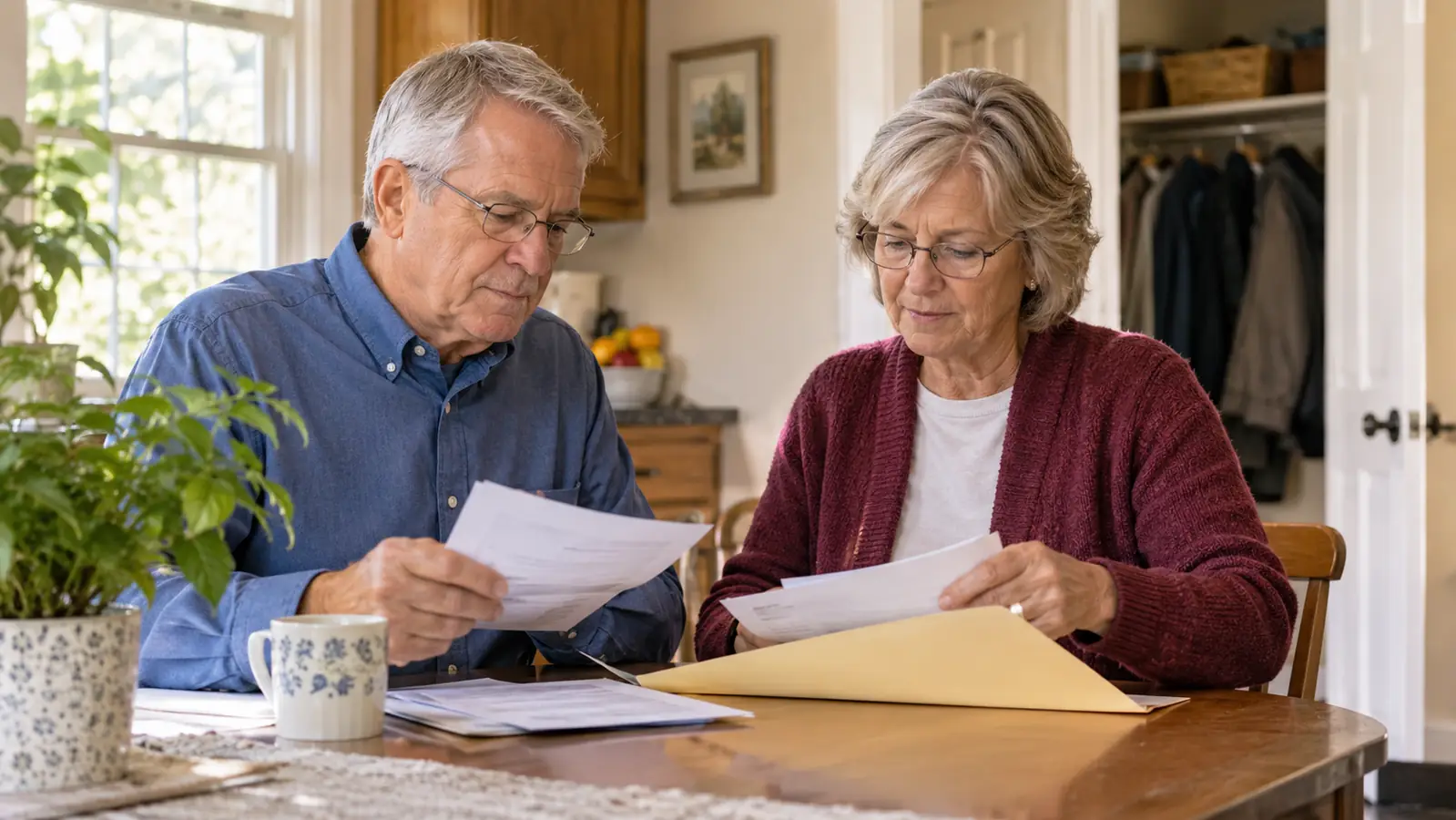
Here is what is in it right now. The deed to the house, both wills, two passports, birth certificates for four grandchildren, Carol's mother's jewelry in a soft pouch, the coin collection my father left me, an envelope of emergency cash, and two backup drives of family photographs going back to the seventies. The document organizer I bought a couple of years back slides in along the bottom and keeps the paper work flat and sorted, which matters more than it sounds like it should. Loose documents in a steel box turn into a shuffled pile inside a month.
I open it once a month, on the first Saturday, and take nothing out. That is on purpose. A combination you have not used in a year is a combination you have already forgotten, and the worst possible time to discover that is midnight with the smoke alarm going and the hallway filling up. Fourteen hundred seconds of practice a year is a cheap insurance policy on the insurance policy. The first three months I did it at the kitchen table with the instruction card in front of me, reading the numbers off one at a time. By the fourth month I could do it standing in a dark closet with the door shut. That is the standard I wanted, and it cost about ten minutes a month to get there.
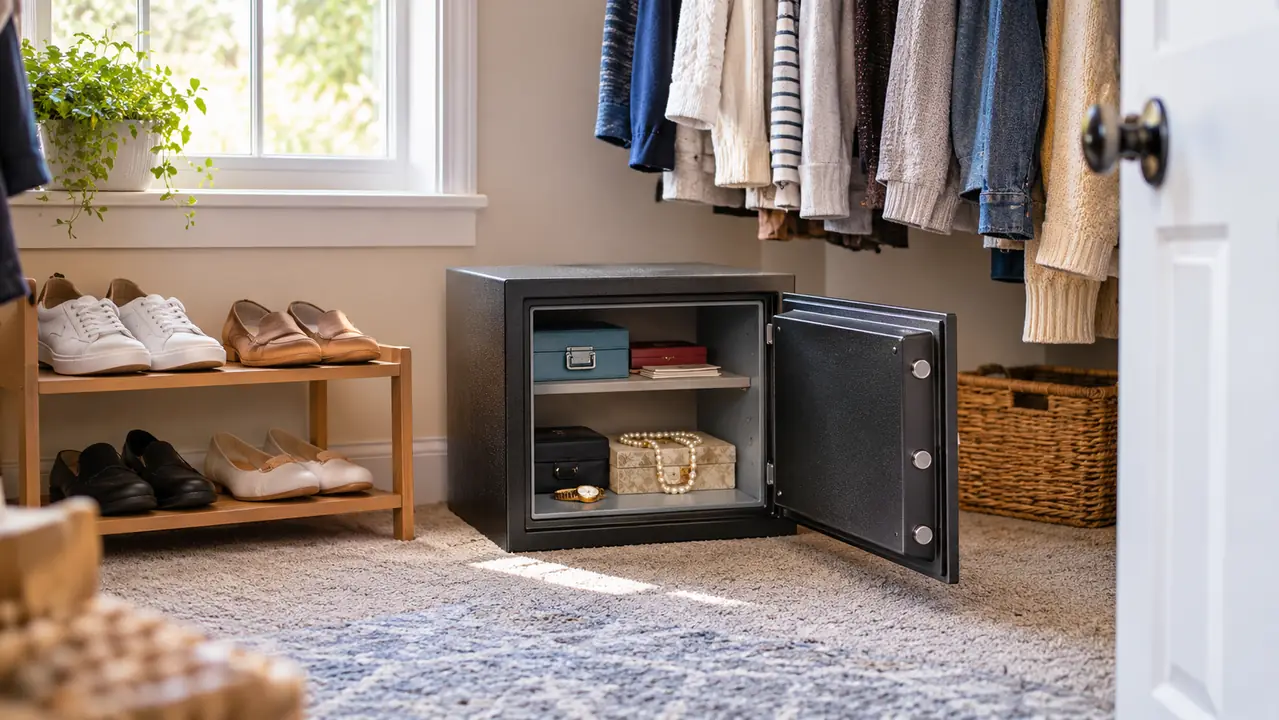
The closet is a walk-in off the bedroom, on the far side of the house from the kitchen, which was not an accident. The safe sits on the floor at the back, behind a low shoe rack, low enough that you would have to be looking for it. Carol keeps her good coat hanging over the corner of it. That is fine by me.
What the One-Hour Fire Rating Actually Means
This is the number that sold me, and it is the number most people misread. The SentrySafe is UL Classified to endure one hour at 1700 degrees Fahrenheit. In kitchen-table terms, 1700 degrees is roughly what a room looks like when everything in it is burning at once, furniture and carpet and the studs behind the drywall. The test is not whether the box survives. The test is whether the inside of the box stays cool enough that paper does not char and curl and turn to the brown flakes I have picked up off closet floors.
One hour is not a promise. It is a head start, and around here a head start is the whole ballgame. In my county the fire department is volunteer, and on a good night they are twenty-five minutes from the station to my driveway. A fire that starts in the kitchen and gets into the attic does not care about that schedule. The hour buys the time between when the alarm wakes you and when the hose is actually on the fire. Nothing more, and nothing less. One claim I still think about had the fire start in an attached garage and run up the wall into a bedroom closet in under twenty minutes. The box on that closet floor carried a sticker that said fireproof and nothing else. The papers inside had fused into a single block, and I could not separate them with a putty knife.
Two honest limits. If the fire starts in the same closet the safe is sitting in, none of the rating matters the way you want it to, because the box is being cooked from six inches away for longer than an hour. And paper is not everything. Photographs, film, and the drives I keep in there all give up at lower temperatures than a deed does. I keep the drives in the safe knowing it is a maybe, not a guarantee.
Water, Which Is How Most Paper Actually Dies
In 31 years of walking through other people's bad days, I saw more documents ruined by water than by flame. Fire hoses put hundreds of gallons into a house. Sprinklers do it faster. A roof opened up with an axe lets a rainstorm in on whatever is left. The papers that survived the heat then sit in a soaked drawer for two days before anybody thinks to look at them.
This safe is ETL Verified for 24 hours of protection in water up to 8 inches deep. That is a real test with a real number attached, not a marketing phrase. It means the box can sit in standing water for a day and the contents stay dry, which covers the plainest version of the bad night: the closet floor with an inch of water on it while the truck is still pumping.
What it does not cover is a basement under two feet of water for a week after the sump pump quits. My basement took on water once in a spring storm, and the safe is not down there. If your only dry floor is a basement that floods, this rating is a reason to look at a different arrangement, not a reason to relax.
Ninety Pounds, and Why It Has to Be Bolted
The outside measures 19.3 inches deep, 16.3 inches wide, and 17.8 inches high, and it weighs 90 pounds empty. That is a two-person lift with a bad grip and a hallway corner to negotiate. Mine sat in the garage for a week while I worked up to it and measured the closet door twice. Measure the door. Measure the turn into the hallway. Then measure the closet floor where you actually want it, because once it is down you will not want to move it again.
SentrySafe intends this one to be mounted to the floor, and mine is bolted down through the bottom. That single afternoon of work is the difference between two different products. A 90-pound steel box sitting loose on a closet floor is a heavy object a thief carries out and opens at his leisure with a pry bar and time. The same box bolted to the joists under the carpet is a problem he has to solve in a dark closet while the neighbors are awake.
I bolted mine on a Saturday in October, through the carpet and the pad, with a drill and a set of bolts from the hardware store. What I got wrong the first time was drilling before I had the box exactly where I wanted it. That cost me a patch of carpet and a second set of holes about four inches off. Sit on the floor with it, open the door, make sure it swings clear of everything, and only then put the bit to the floor.
I will say the plain thing here that a lot of reviews skip. This is not a burglary-rated safe in the sense a bank has one. It is alloy steel, it is heavy, it has a lock and it has an anti-theft alarm listed on the spec sheet, and none of that stops a determined man with the right tools and no clock. What it does is make your papers a worse target than the television in the front room.
What Actually Fits, Measured
The chamber inside measures 8 inches wide, 11.9 inches deep, and 13.8 inches high. Read that width again, because it is where expectations go wrong. A standard letter-size file folder does not lie flat in an 8-inch-wide chamber. Neither does a coin album. Paper goes in on edge or at a slight angle, and if you want it organized rather than piled, you need a folder or an organizer rather than a shoebox's worth of loose sheets.
What 1.2 cubic feet actually is, in practice, is about one deep file drawer. It holds a family's core documents, a jewelry pouch, a coin collection in albums standing upright, and the drives, with room left for an envelope of cash on top. It does not hold the photo albums, the silver, and your grandmother's china. If you are picturing a closet archive, buy a bigger box and accept that it will weigh twice as much and take two of you to carry.
The Keypad, the Key and the Alarm
The lock is a digital combination you set yourself, with a secondary key that opens it the old way. That key is the reason I am not nervous about the electronics. A keypad that has sat in a closet for fifteen years is a keypad that may or may not wake up on the night you need it, and I have no interest in being the man on the front lawn explaining to a fire marshal which number I might have changed it to.
Where the SentrySafe earns its keep is that the keypad is a convenience, not the only way in. I set the combination once, wrote it in pencil in a notebook that stays at our daughter's house, and have not changed it since. If the electronics ever quit on me, the key still turns.
The spare key lives with our daughter across town, not in the house and not in the garage. A key kept in the same building as the safe is a key that has already failed at its one job. I can work the keypad by feel now without looking, which is worth practicing if your closet is as dark as mine.
On the alarm: the spec sheet lists an anti-theft alarm, and I have never set it off by accident or otherwise, so I cannot tell you how loud it is in a real break-in. What I can tell you is that the one-year limited warranty is the thinnest part of this whole package. A safe is a product you expect to still be doing its job in 2050. One year of coverage is not much of a handshake, and it is the single detail I would change if I could.
What I Liked
- UL Classified for one hour at 1700 degrees, which is a tested rating and not a phrase on a box
- ETL Verified waterproof for 24 hours in up to 8 inches of standing water
- Digital combination plus a secondary key, so a dead keypad is an inconvenience instead of a crisis
- 90 pounds of alloy steel and a floor-mount design that lets you make it genuinely hard to walk off with
Where It Falls Short
- The chamber is 8 inches wide, so letter-size folders and coin albums will not lie flat inside
- One-year limited warranty on a product meant to sit in a closet for decades
- 90 pounds empty makes it a two-person job to move and a real hassle to relocate later
- Not a burglary-rated safe. Bolted and alarmed is not the same as impenetrable
A safe is not a vault. It is a head start, and a head start is what most families actually needed and did not have.
Who This Is For
This is for the homeowner who has a deed, a will, a passport, a coin collection, or a piece of jewelry that would be genuinely painful to lose and who is currently keeping it in a dresser drawer, a shoebox, or a plastic tote in the basement. It is for the person who will actually bolt it down, check the combination once a month, and put the spare key somewhere other than the kitchen junk drawer. If that is you, 1.2 cubic feet holds the important things, the one-hour rating buys the time your fire department needs, and 90 pounds of steel turns a five-minute grab into a decision a thief has to make in the dark.
Who Should Skip It
Skip it if you want to keep photo albums, silver, and a lifetime of paper in one place, because this is a file drawer's worth of space and you will be disappointed by the second week. Skip it if you are not going to fasten it to the floor, because a loose 90-pound box is the worst of both worlds. Skip it if you are renting a place with a concrete slab you cannot drill, or if the only spot you have is a basement that floods past 8 inches, or if you want a warranty longer than a year. And skip it if what you actually need is a small lockbox for a handgun by the bed. That is a different product with a different job, and this closet safe is not it.
Eighteen months in, mine is still bolted to the closet floor
1.2 cubic feet of alloy steel, UL Classified for one hour at 1700 degrees, ETL Verified for 24 hours in water up to 8 inches, with a keypad and a backup key. Measure your closet door before it arrives.
Amazon Check Today's Price on Amazon →