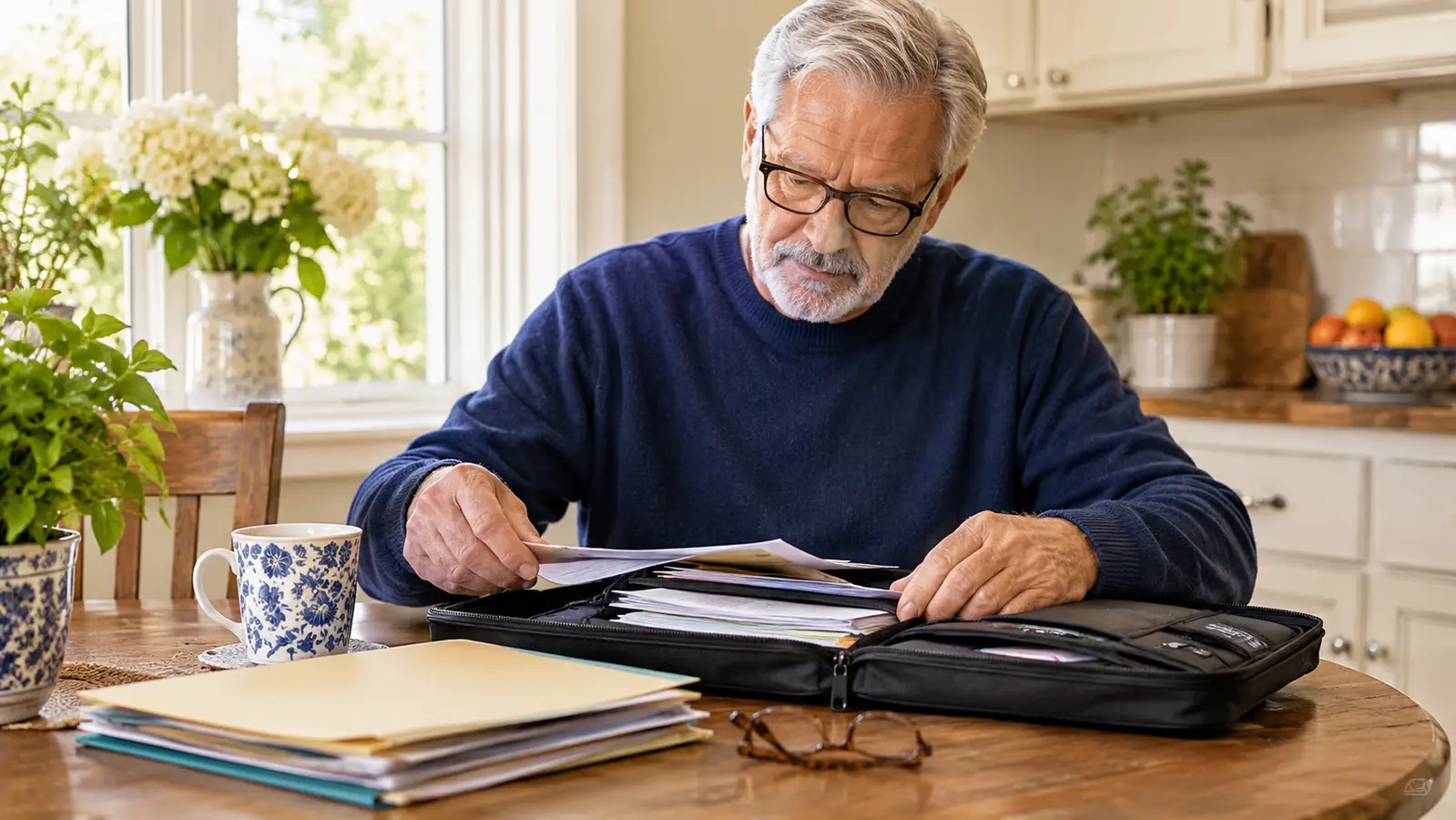
I bought the DocSafe 5200°F Fireproof Document Organizer about two years ago, and I have a complicated relationship with it. It does most of what the listing says. It also does a few things the listing conveniently leaves out. In 31 years as a homeowner insurance claims adjuster, I walked through hundreds of burned, flooded and burglarized homes, and I saw the same thing every time: people lost the papers that proved who they were and what they owned. My wife Carol and I keep our deeds, passports, wills, birth certificates and some emergency cash in this organizer. So this is not a review from a man who unboxed it on camera and read the bullet points back to you. It is what I would tell a neighbor on the driveway.
The short version: for papers you need to grab and go, it is a sensible buy. For anything you expect to survive a house falling on it, keep reading, because that is not what this is. I will get into the fire rating, the lock, the zipper and the two things that annoy me every time I open it.
The Quick Verdict
A well-organized, genuinely heat-resistant document case for the homeowner who wants one grab-and-go place for papers. It is a soft case with a lock, not a vault, and the listing should say so more clearly.
Amazon Check Today's Price →The case I would grab on the way out
If your papers are spread across three drawers, this is the simplest fix I have found. It holds the deeds, the passports and the folders in one place, and the handle means you can carry it out in one trip.
Amazon Check Today's Price on Amazon →What the DocSafe Organizer Actually Is
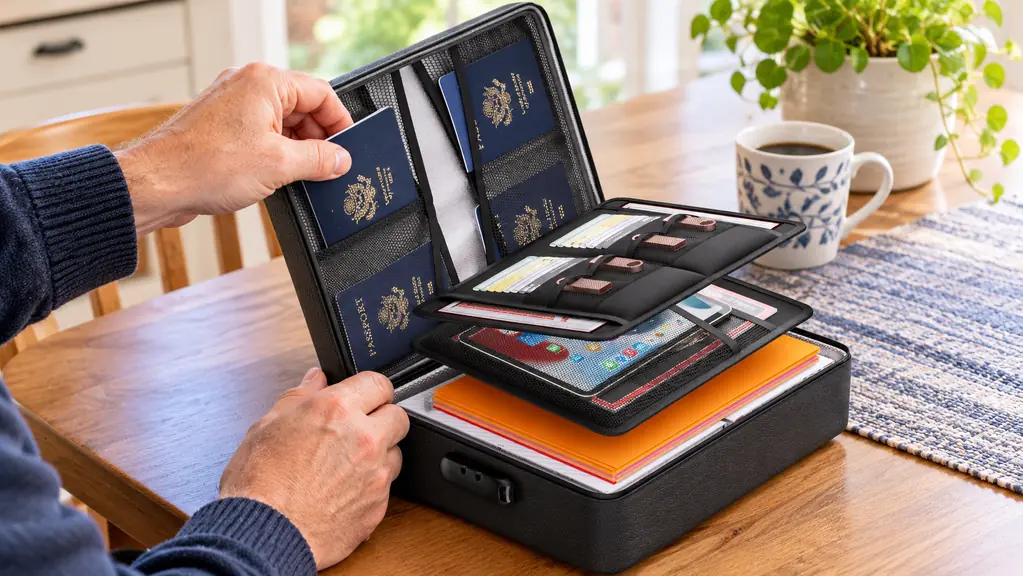
The listing calls it a box, but the one that arrived is a soft-sided case with a zipper around three sides and a strong handle. It measures 15 inches long, 11 inches wide and 4.1 inches tall, and it weighs 16 ounces empty. The shell is soft, which matters more than any other detail in this review. Inside there are 8 compartments, 8 passport mesh pockets, 16 card slots, 4 U Disk pockets and 7 folder layers, for a listed capacity of 621.48 cubic inches. On a closet shelf it takes up about the footprint of a large folder. The handle is stitched on and sits flat when you set the case down. There is no rigid frame, no metal edge and no lid that stays open on its own. That last part sounds small until you are trying to load seven folders with one hand while the phone rings.
That is enough for the paper that runs a household. Deeds, titles, wills, birth certificates, passports, insurance declarations, a folder of tax records and the backup drives of family photos I keep meaning to rotate. The folder layers take standard letter folders. The mesh pockets hold passports where you can see them. The card slots are sized for insurance cards and the like. It slides onto a closet shelf the way a large folder does. I keep the passports in the mesh pockets so I can count them at a glance before a trip. The cash goes in a sealed envelope in one of the compartments, not loose, because loose cash in a case with a combination lock is an invitation to forget how much was there.
What it is not is a safe. There is no keypad, no bolt, no alarm, no app and nothing to anchor it to a floor. The lock is a combination lock on the zipper pulls. That is a deterrent to a curious grandchild or a smash-and-grab burglar with 90 seconds in your bedroom. It is not a deterrent to anyone who decides to carry the whole case out the door, which is the honest weakness of every portable document case ever made. I am not saying that to run it down. I am saying it because the word safe gets used loosely in listings, and a soft case with a lock is not the same object as a steel box bolted through a closet floor. They solve different problems, and one of them is not burglary.
How I've Used It for Two Years
This case lives on the top shelf of our walk-in bedroom closet, and it has been there since about two years ago. I bought it after the spring our basement took on water. Nothing important was down there that time, but it was a warning I did not ignore. The deeds, the wills, our passports, the birth certificates, Carol's mother's jewelry in a small pouch and some emergency cash all went into it. The coin collection stayed in the steel safe I added later, because coins are heavy and this case is not built for weight. The handgun stays in its own locked box, well away from the grandchildren, and it does not belong in a document case. That is a different subject with a different set of rules.
The routine is simple. When we travel, the passports come out of the mesh pockets and go back in when we return. When a grandchild is born, the birth certificate copy goes into a folder layer. When the insurance renews, the new declarations replace the old ones. The handle is the part I use most. It is stitched on well and has not pulled loose, even when the case is loaded with folders and I am carrying it one-handed down the hall. The combination is set once and then it is just memory. I will not pretend I have never stood in the closet at 5 in the morning, fumbling with that little lock half asleep. That is a me problem, not a case problem, but it is part of living with a combination lock.
Two years in, the zipper still runs clean. The combination lock still catches. The outside has a few scuffs from sliding on and off the shelf, but nothing has torn and no seam has opened. What has not held up perfectly is the shape. Loaded with seven folder layers, the case sags in the middle when you pick it up by the handle. It is a soft bag doing a soft bag's job, but if you expect it to stay square like a file box, you will be disappointed. I have also learned not to overstuff it. The zipper will close with a bulge, but the bulge puts strain on the seams and makes the whole case harder to slide onto the shelf. Treat the listed capacity as a limit, not a challenge.
A fire bag buys you minutes to get your papers out the door. It does not make them invincible, and any listing that hints otherwise is selling you a feeling.
What Nobody Tells You About Fire Ratings
Here is the part I wish more listings would say out loud. A temperature rating and a fire rating are not the same thing. The DocSafe listing leans on 5200°F, and I do not doubt that the eight layers were tested to something like that in a lab for a short period. What it does not give you is a UL class or an hour rating, which are the two numbers I actually want. Paper chars and then burns at around 451°F. A house fire can reach well past that in a room and stay hot for a long time. A soft case with heat insulation buys you minutes. It does not buy you hours. I saw file cabinets that looked fine from the hallway and held nothing but ash inside. The fire did not have to reach the cabinet directly. The heat in the room was enough.
Minutes matter. In my claims years, the people who saved their papers were the ones who had them in one place and could carry them out. The people who lost them had them in a drawer, a shoebox or a filing cabinet that got hosed down by the fire department. If the case is on a closet shelf near the front door and you can grab it on the way out, that is worth more than a fancy rating on a box in the basement. The other thing that matters is where you keep it. A closet shelf on an interior wall is better than a garage shelf against an exterior wall. Heat rises, smoke travels, and the garage is the first thing to go. If you would not store your tax returns in the garage, do not store this case there either.
The weak point on any soft case is the closure. The zipper and the seams are where heat and water get in first. This one has a zipper around three sides and a soft shell, and water resistance is listed, but I would not float it in a flooded basement and expect dry paper on the other side. If water is your main worry, a case like this on a high shelf is better than a drawer. If fire is your main worry, it is better than nothing and worse than a rated safe. I keep mine above the water line and away from the floor. That is not a guarantee. It is just a habit that takes no extra work.
None of that makes it a bad product. It makes it a document bag. The mistake is buying a document bag and believing you bought a vault.
What I Liked
- Eight layers and a 5200°F peak rating give you real minutes of protection, which is more than a shoebox gives you.
- The inside is genuinely organized: 8 compartments, 8 passport mesh pockets, 16 card slots, 4 U Disk pockets and 7 folder layers.
- At 16 ounces empty, with a strong handle, it is easy to grab and carry in one trip.
- The combination lock stops casual snooping and keeps grandchildren out of the passports.
- Two years in, the zipper, handle and seams have held up.
Where It Falls Short
- It is a soft-sided case, not a rigid safe, even though the listing calls it a box.
- No UL class or hour rating is given, so the 5200°F number is a peak temperature, not a duration.
- The zipper and seams are the weak point for heat and water.
- It sags in the middle when all seven folder layers are loaded.
- The lock is a deterrent, not real security. Anyone can carry the whole case away.
The Lock, the Zipper, and the Daily Annoyances
The combination lock is the feature that sells this case, and it is the feature I have the most mixed feelings about. It does what it says: the zipper pulls lock together, and you need the combination to open it. That keeps the grandkids out of the passports and keeps a snooping houseguest from flipping through your will. It does not keep out anyone who walks off with the case. A soft shell and a zipper are not a serious obstacle to a person with a knife and a minute alone. I tested that theory on an old nylon bag in my shop, not on this case, and I will spare you the details. The point is that portable storage is portable. The lock is for privacy, not for security.
In daily use, the zipper is the small annoyance. The pulls are close together and the lock sits on top of them, so opening it takes two hands and a little patience. In a hurry, in the dark, with the power out, that is not the moment you want to be fiddling with a combination. I have gotten faster at it. Carol has not, and she has said so more than once. The card slots are tight when new, and the passport mesh is snug enough that you have to work a passport out with two fingers. That is good for keeping things in place and bad for a fast exit. A little slack would be a kindness.
I also wish the case had a way to tether it. It does not. There is no grommet, no cable loop and no strap point other than the handle. If a burglar has time to open a closet, he has time to pick up a 16-ounce case and walk. Bolting a steel safe to the floor solves that. A soft case cannot, and pretending otherwise is how people get disappointed. What the case does well is keep everything in one place, which is more than most households manage. The number of people who keep a will in one drawer and the deed in another is higher than you would think. I was one of them.
What I Would Change
I would change the way the fire protection is described. Give me an hour rating and a UL class, not just a peak temperature. The peak number is the one that looks best on a listing, but the hour rating is the one that tells me whether my papers have a chance in a real fire. If a manufacturer cannot get a UL class on a soft case, say so and explain what the case is actually for. That is not a knock on this specific case so much as a knock on the whole category. The category would be better if the numbers were standardized. Until they are, a shopper has to read carefully and ask what the number means.
I would put a small label card inside each folder layer, or at least a place to write one. When you have seven layers and 8 compartments, you end up opening three of them before you find the passport. A strip of masking tape and a pen solves it, which is what I did, but a case that is built for organization could go one step further. I would also make the zipper pulls a little easier to separate. My hands are 71 years old and they work fine, but they are not as quick as they were. A case that is meant for documents is often used by people my age, and the little things matter.
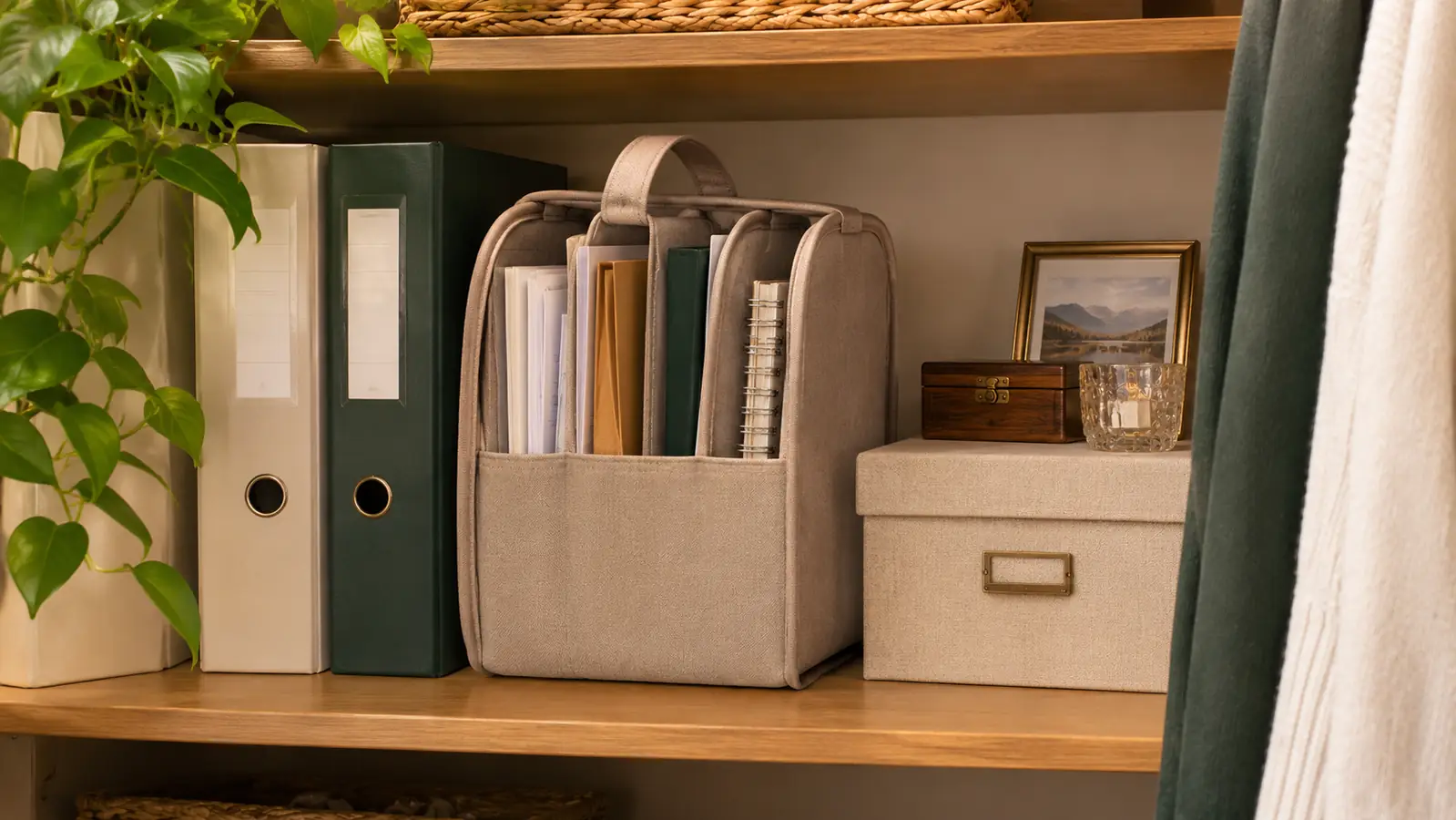
I would not change the size or the weight. At 15 by 11 by 4.1 inches and 16 ounces empty, it fits where a safe will not. That is the whole reason it earns a place in the closet. A heavier, rigid version would protect more and get used less, and a document case you do not use is just a fancy empty box. I would also make it clear that the case is not a substitute for a safe. The listing can say that without scaring anyone off. The people who need a safe will still buy a safe. The people who need a grab-and-go case will buy this one with their eyes open.
Who This Is For
This is for the homeowner who wants one place for the papers that prove who they are and what they own. The renter who has moved three times and keeps the lease in a kitchen drawer. The adult child cleaning out a parent's house and looking for something better than a shoebox. The couple who travels twice a year and spends the night before the flight looking for passports. If you want a case that fits on a closet shelf, holds letter folders, keeps the grandkids out and gives you a few extra minutes in a fire, the DocSafe organizer is a sensible choice. It is not the only choice, but it is one I have lived with.
Who Should Skip It
Skip it if you want a safe. If your main worry is burglary, a soft case with a combination lock is a carrying case for your valuables, not a barrier. Skip it if you have documents that a court or a bank insists stay in a rated container. Skip it if you need to protect heavy items, a coin collection or a handgun. Skip it if you will put it in the basement and forget it, because a soft case in the lowest, wettest part of the house is the same mistake as a shoebox in a drawer. And skip it if you want a case that stays square and stacks like a file box. This one sags when it is full, and no amount of wishing will change that.
One place for the papers that prove everything else
You do not need a vault to get organized. You need one case, one shelf and the habit of putting things back. The DocSafe organizer has done that job in my closet for two years.
Amazon See It on Amazon →