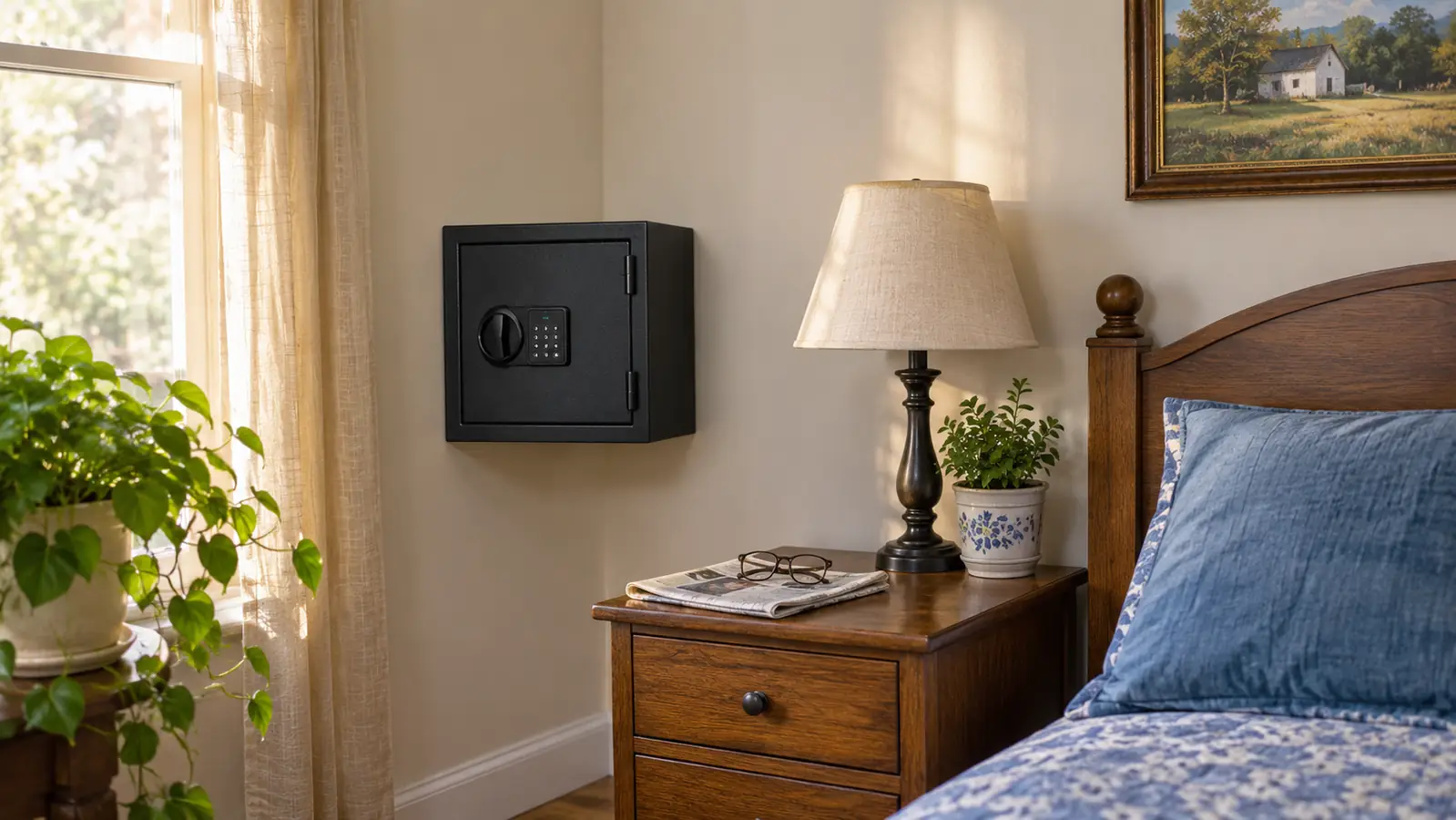
For eleven years I kept a revolver in the top drawer of my dresser. It was unloaded. I told myself that unloaded and careful were the same thing, and I believed it right up until the Saturday my youngest granddaughter went looking for a hairbrush and started opening drawers one after another, the way a six-year-old does. She never reached the third drawer. Carol called her back to the kitchen for lunch. Nothing happened that day, and I still did not sleep that night. Within a week I was reading about lock boxes, and about a year ago I mounted the ONNAIS Iron PRO to the wall beside my side of the bed.
I spent thirty-one years as a homeowner insurance claims adjuster, and I have walked through more burglarized houses than I can count. The guns were rarely what got stolen. The gun was usually the thing the homeowner was sick about, because a firearm that ends up in the wrong hands is a problem no claim form can fix. This is not an article about being afraid of your own neighborhood. It is the list of five steps I actually took, in the order I took them, including the two I got wrong first.
The box I bolted beside my bed, and why the dresser drawer was never going to be enough
The ONNAIS Iron PRO is a wall-mounted steel lock box with a fingerprint reader, a keypad and a backup key. It measures 9.17 inches wide, 3.07 inches tall and 2.91 inches deep, which is the entire reason it fits between my nightstand and the closet door frame. Current price is on the listing.
Amazon Check Today's Price on Amazon →Five Steps, In Order
Step 1: Pick the spot by how you will reach it at 3 a.m.
Most people shop for the box first and then walk around the room looking for somewhere to put it. Do it backwards. The ONNAIS is a wall-mount safe, not a desk box, and once you accept that, the room narrows itself down in about ninety seconds. Mine went on the wall at 9.17 inches wide and 3.07 inches tall, which slid in between the nightstand and the door frame with room to spare. Nothing on the wall had to move. Nothing on the nightstand had to move either, which mattered, because that is where my glasses live.
Reach beats concealment. Put the reader at the height your hand would naturally touch if you sat up in bed at two in the morning with the lights off. For me that is just below shoulder height while sitting. A box mounted above eye level is a box you fumble at, and fumbling in the dark is how people start leaving the door cracked open because it is easier.
The other thing I weighed was where the grandchildren sleep when they stay over. Two of them use the back bedroom. That is forty feet and two doors from my side of the bed, and I wanted more distance than that, so the box went on the far side of the nightstand, angled toward the corner. It is not hidden. Hiding was never the job. The job is that opening it takes a deliberate act from an adult, not a wandering hand.
Step 2: Bolt it to framing, not to plaster.
A box this size is easy to carry, and that is the honest trade-off you accept when you buy something that fits beside a nightstand. An adult can walk off with it. So can a teenager. The mounting type listed for the ONNAIS Iron PRO is wall mount, and I took that word seriously rather than treating it as a suggestion.
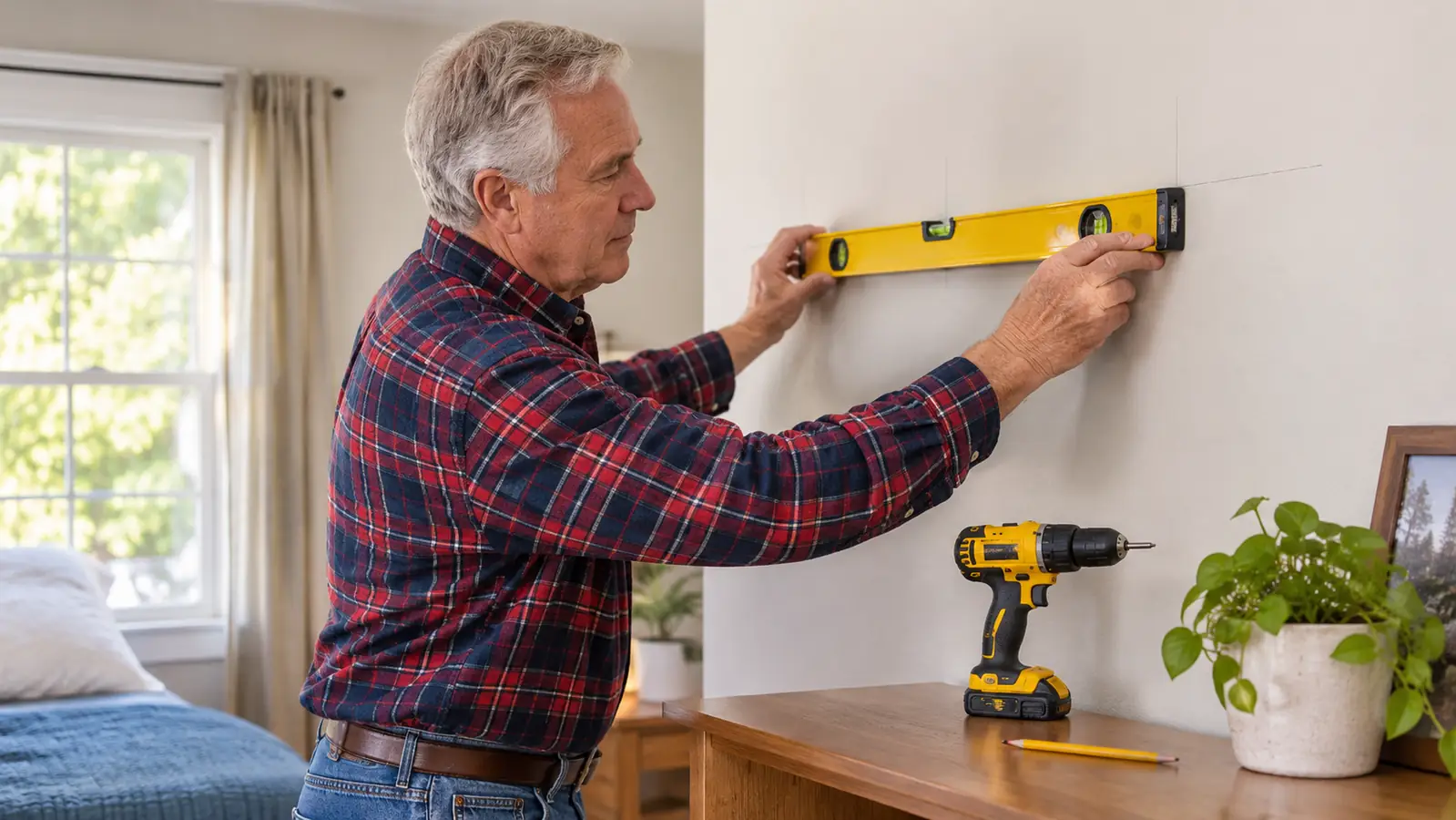
I found two studs with a magnetic stud finder, marked a level line between them, and drove the mounting screws into the framing instead of into the plaster alone. Our house is a single-story brick ranch built in the sixties, so some interior walls are lath and plaster and some are drywall, and the studs run sixteen inches on center in both. If you cannot line up on a stud, screw a backing board across two studs and mount to the board. A hollow-wall anchor will hold a picture frame. It will not hold a lock box that somebody is yanking on.
The reason to bother is leverage. A safe sitting loose on a shelf can be tipped, carried into the garage and worked on at leisure, with a pry bar and all the time in the world. The same safe bolted to a wall stud has to be pried off the wall first, which is loud and slow and takes two hands. I am not going to tell you that makes it impossible. It makes it a poor use of a burglar's evening, and that is the realistic standard.
Step 3: Load it the same way every single time.
The chamber is 2.91 inches deep and the listing rates the box for two, so there is room for a pistol and a spare magazine, which is exactly what mine holds and nothing more. What matters is not what goes in but that the same thing goes in the same way, in the same orientation, every single time. Muscle memory is the whole point of a quick-access box. If the grip faces left one week and right the next, the hand that reaches in blind has to stop and think, and thinking is the one thing you do not want to be doing at two in the morning.
My routine is short. Magazine out, chamber empty, pistol set in the same slot with the grip toward the door hinge, magazine laid flat beside it. I check it every Sunday evening when I check the smoke alarms. That is the entire procedure and it takes about eleven seconds, which is a fair price for never having to wonder.
The backup key does not live in the bedroom. That sounds obvious and it is the mistake I made first. I had the key in the nightstand drawer for about three weeks before it occurred to me that the drawer is precisely where a curious kid goes, and that I had spent good money on a lock and then left the key in the one place a child already knows to look. It now lives inside the fire safe bolted to the closet floor, which is a different lock in a different room, and Carol knows where. There is a second one in a sealed envelope in the basement fire box.
Step 4: Set up all three ways in and test them before you trust them.
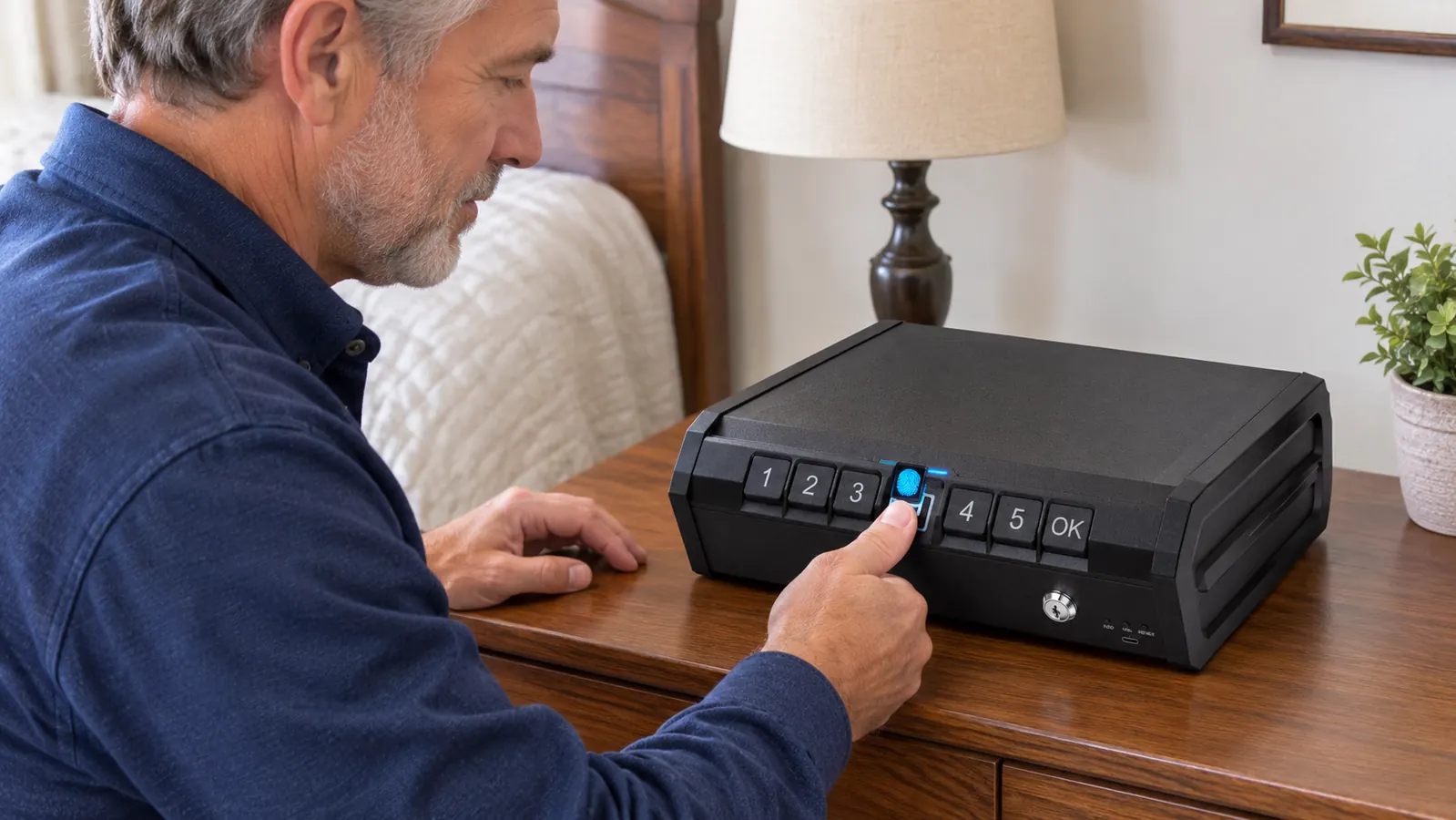
The ONNAIS Iron PRO gives you three ways in: the fingerprint reader, the keypad, and the backup key. I enrolled my thumb and both index fingers, then had Carol do the same with hers. Two people, several prints each, and none of them belong to me alone. If I am in the hospital for a week, Carol does not have to find me in order to get into the box beside her own bed.
Test every method with the door propped open first, then test it twenty times in a row. Fingerprint readers are not magic, and anyone who tells you theirs works first try in every condition has not owned one through a Kansas January. My hands get dry enough in winter that the reader takes two tries unless I press flat and hold for a beat. I would much rather learn that in my own bedroom on a Tuesday afternoon than in the dark with my heart going.
The third way in matters more than people give it credit for. The listing notes that if the battery dies and the key is not available, you can connect a power source and unlock with your fingerprint or password. That sentence is the reason I bought this box, because a biometric safe with a dead battery and a lost key is a steel brick with a nice finish. Change the battery on a schedule, not on a warning light. I do mine the same weekend I change the clocks, and I write the date on a piece of tape inside the closet door so I cannot talk myself out of it.
Step 5: Decide who knows, and put nothing in writing.
The adults in the house should know how the box works. The children should know that it exists, that it is not theirs, and that they come and get me if they ever see it standing open. That is the script I gave all four grandchildren, ages six to fourteen, and I gave it in front of their parents so that every adult in the room was using the same words. A rule that only one household enforces is a rule children learn to route around.
What I did not do was write the code on a sticky note, or park the spare key on the closet shelf next to the wrapping paper. In my working years, the most common failure I saw was not a lock that got picked. It was a key that got found. Children know where their parents hide things. They know where grandparents hide things too, and they have idle time and no fear whatsoever.
One more thing, and it is uncomfortable. If the reason a firearm is in your house involves a person in that house being at risk, a lock box is one layer and not an answer. The rest of the layers are a straight conversation with your family and, if it comes to it, a call to somebody qualified to help. I say that as a man who spent three decades reading police reports, not as anybody with a license to give advice.
The lock is identical whether the box is bolted to a wall stud or sitting loose on a shelf. The protection is not.
What Else Helps
Ammunition lives somewhere else. Mine is in a metal can in the garage, inside the locked cabinet with the tools, not in the box beside my bed. If somebody does get that door open, they get an empty gun. That is a bad afternoon and not a tragedy, and the difference between those two things is where you store the magazine.
The ONNAIS is alloy steel with an electronic combination lock, a fingerprint reader and a keypad, and it is not a fire safe. I want to be plain about that, because these boxes get sold as though they protect paper, and they do not. Mine holds a handgun and one magazine and nothing else. The deeds, the passports, the birth certificates and Carol's mother's jewelry are in the fire safe bolted to the closet floor, and the photo drives and my father's coin collection are in the basement organizer, up off the concrete where the water came in during that spring storm. Different jobs, different boxes. Buying one box for everything is how people end up with a wet passport.
A cable lock threaded through the pistol, inside the box, costs little and adds a step for anyone who does get the door open. So does a five-minute walk-through on the first of every month: open it, look at it, confirm the battery date, close it, and check that the mounting screws are still tight. A screw that has backed out a quarter inch over two winters is a screw you want to find yourself, before somebody else finds it for you.
And tell the people who need to know. Both of my grown children know where the box is and how it opens. If something happens to me, the last thing I want is my son hunting for a key in a drawer while four grandchildren are running through the house. That conversation took ten minutes and it is the cheapest safety step on this entire list.
Five steps, one wall stud, and a box that opens three ways
The ONNAIS Iron PRO is 9.17 inches wide, 3.07 inches tall and 2.91 inches deep, mounts to the wall, and opens by fingerprint, keypad or backup key. Connect a power source if the battery ever dies. Current price and shipping details are on the listing.
Amazon See Current Price on Amazon →