

I spent thirty-one years as a homeowner insurance claims adjuster, and I walked through a lot of houses after the fire truck left. The thing that stayed with me was never the furniture. It was the paperwork. A deed burns, and the survey that proves where the property line sits burns with it. A passport goes, and a trip that took a year to plan goes with it. A will goes, and a family that was already having the worst week of its life starts arguing about a document nobody can produce.
So when I retired to a brick ranch outside Wichita, I did not put our papers in a shoebox on a closet shelf. I bought a DocSafe fireproof document organizer about two years ago, and it is the first thing I would replace if it disappeared tomorrow. Not because it is fancy. Because it forces a system. The thing weighs sixteen ounces, measures fifteen inches by eleven by four, and it holds more of our life than any single drawer ever did. Here is the exact order I would do it in if I were starting over this Saturday morning.
Buy the Box First. The Sorting Goes Faster When There's Somewhere to Put It.
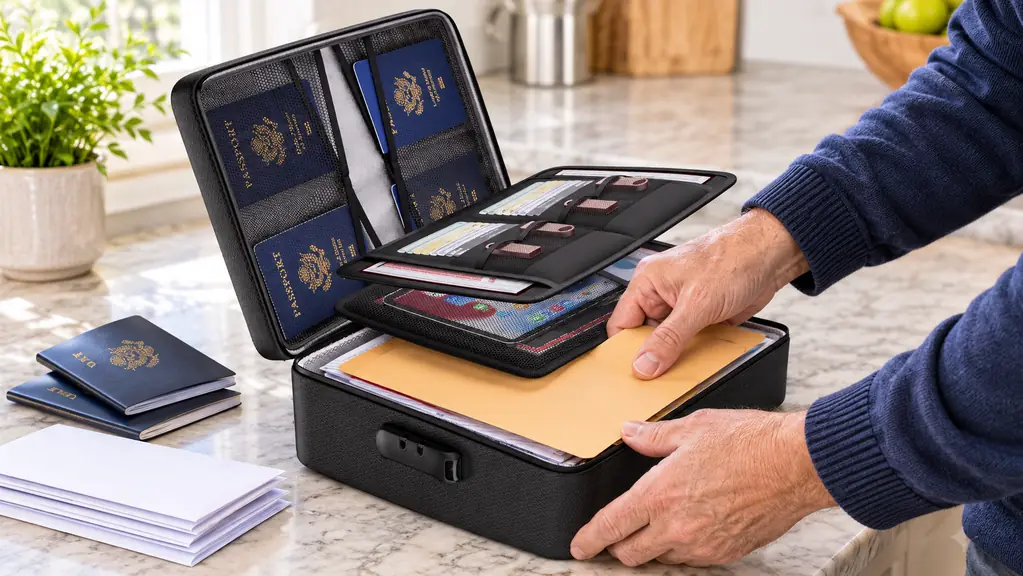
The DocSafe organizer is 15 by 11 by 4.1 inches, 16 ounces, with 7 folder layers, 8 compartments, 16 card slots and 8 passport mesh pockets. It is the container. Your job this weekend is the contents.
Amazon Check Today's Price on Amazon →The Five Steps, in the Order I'd Do Them
Step 1: Get Every Paper in the House Into One Room
Start with a box of grocery bags and one Saturday morning. Not a whole weekend. One morning, and then you stop, because a project you can finish beats a project you abandon on the floor of the den.
Go through the house in a fixed order so you do not wander and quit halfway. Filing cabinet first, then the desk drawers, then the bedroom closet shelf, then the basement, then the glove box of the truck. Every piece of paper that could conceivably matter goes into a bag, and every bag goes to the kitchen table.
That closet shelf cost me twenty minutes on its own. Carol keeps a shoebox up there with every card the grandchildren ever sent us, and I sat down on the floor with that box across my knees before I remembered the rule and put it back where it came from. Greeting cards are not paperwork. They have their own place in this house, and it is not inside a fireproof organizer.
Do not read anything yet. This is the rule I broke the first time and it cost me an entire afternoon. The moment you stop to read a 1998 insurance declaration, you are done. You will find three more things to read behind it, and by suppertime the bags are still on the table and the project has died. Reading comes later, when you have a pile small enough to make decisions about.
Step 2: Sort Into Four Stacks, Not Fifty
Four stacks. Not one per family member, not one per account, not one per decade. Four.
Stack one is keep forever. Deeds and titles, birth certificates, passports, Social Security cards, the will, the powers of attorney, military discharge papers, current insurance policies. Stack two is keep for now. Tax returns inside the last seven years, the appliance warranty cards that still mean something, medical records you are still arguing with somebody about. Stack three is shred. Anything with an account number, a signature or a Social Security number on it that you no longer need. Stack four is somebody else's copy, which is the pile most people forget: the photocopies you made for a loan application, the duplicate statements, the second and third copies of a policy you consolidated ten years ago.
Carol and I bought a cross-cut shredder years ago and it has earned its keep. Stack four goes in the recycling. Stack three goes through the shredder while you watch. That leaves two stacks worth protecting, and that is the whole point of the morning.
Step 3: Decide What Has Actually Earned a Place in the Box
Here is where you need to be honest about capacity. A DocSafe organizer is not a filing cabinet and it is not a safe. It is fifteen inches by eleven by four and a little over a pound, which means it holds a great deal of what matters and none of what does not. I have never once gotten a year of tax returns in mine and I have never needed to.
A word on what did not fit the first time I tried. I wanted every property tax bill going back to 1994 in there, because they felt official and I was raised not to throw away anything with a county seal on it. Four folder layers vanished before I ever reached the deed to the house. Those bills went to a scanned folder on the drive, and nine of the ten things I actually needed that year still slid in without a fight.
The way I explain it at the kitchen table is this. Imagine standing in a hotel parking lot at eleven at night after a pipe burst or a wildfire evacuation, and somebody asks you to prove who you are, what you own, and what you want done with it. Whatever you would need in that parking lot is what goes in the organizer. The scanned copies of everything else can live on a drive or in a folder, because a photocopy of a deed is useful but the original is what settles an argument.
This is also the moment to be straight with yourself about what a soft-sided fireproof organizer is and is not. The DocSafe lists eight fireproof layers rated to withstand temperatures up to approximately 5200 degrees Fahrenheit, and a waterproof shell. That is a real rating and it is why the thing exists. But a rated bag is not a UL-class insulated safe, and a house fire that burns for hours is a different animal from a fire that is knocked down in minutes. What the organizer buys you is a much better chance, plus a handle and sixteen ounces of weight so you can carry it out the door on the way to the truck. I would not oversell it to you. I would also not go back to the shoebox.
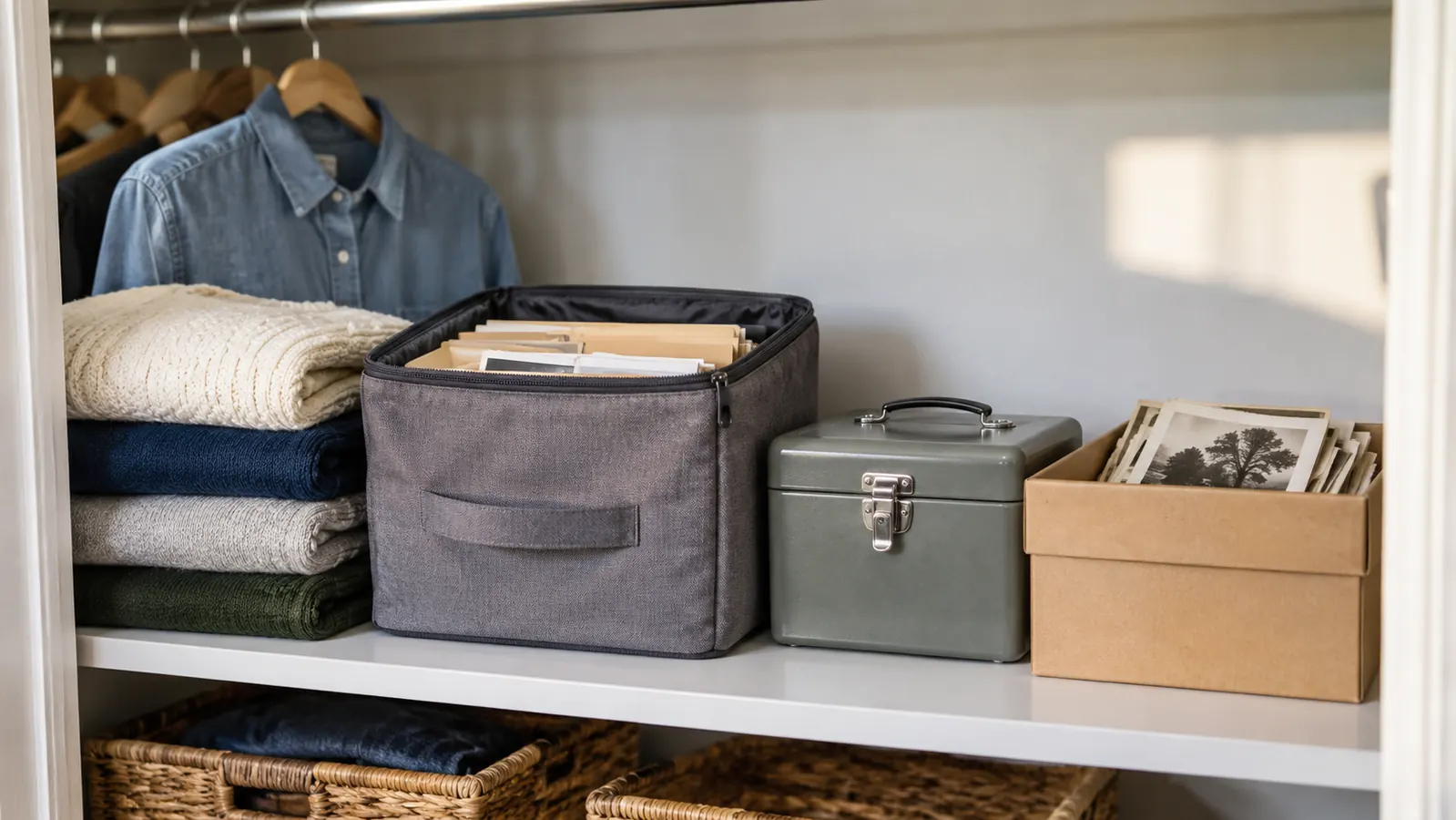
Step 4: Load It by Layer So You Can Find Something Without Dumping It
Most people open a document organizer, stuff it, and then panic at the accountant's office six months later. Load it by layer instead, so a stranger could find your will in under a minute.
Put passports and Social Security cards in the eight mesh pockets on the inner flap, one per person or one per document. Put the wallet cards in the sixteen card slots, which sounds excessive until you are counting insurance cards, Medicare cards and a couple of account cards. Put the backup drives of family photos in the four U disk pockets, because a drive that rattles loose inside a folder layer will not survive the trip. Then use the seven folder layers for the flat paper: deeds and titles in one, insurance policies in another, wills and powers of attorney in a third, tax returns in a fourth. The main pocket takes the odd sizes, like the title for the truck or a sealed envelope to be opened by somebody else.
I also learned to leave the folder layers a little loose. My first pass was packed so tight that closing the zipper took two hands and a knee, and the mesh pockets on the flap stopped lying flat. An organizer you have to fight is an organizer you stop opening. Leave a finger's width of slack in each layer, and the whole thing shuts with one pull and still carries by the handle in one hand.
Write a single index card with the layers listed in order and lay it on top before you close the zipper. I do that because I am seventy-one and I do not trust my memory on a bad day, and because if something happens to me, Carol or one of the kids needs to open that box in a hurry without a guided tour. The index card is the cheapest improvement I have made to the whole system.
Step 5: Lock It, Tell One Person, and Put a Date on the Calendar
The DocSafe has a combination lock on the zipper closure. Set it to something you can remember without writing it on anything that lives near the box. Do not tape the combination to the underside of the shelf. In thirty-one years of claims work I saw that particular mistake in more houses than I can count.
Be clear-headed about the lock, though. On a soft-sided organizer, a combination lock on a zipper is a deterrent against a curious grandchild or a nephew with bad timing. It is not a vault. If a determined thief walks into your bedroom with a knife, he does not need the combination. Which is exactly why the gun, the jewelry and the coin collection belong somewhere heavier, and why the organizer belongs somewhere a thief would have to look for.
Then do the part almost everybody skips. Tell one other adult in the house where the organizer lives, and put a recurring date on the calendar, once a year, to open it. Things change: the mortgage gets paid off, the policy gets replaced, a grandchild gets a passport. I go through ours every January, replace anything stale, and check that the shelf it sits on is still dry. A box you never open is just a drawer with a lock on it.
Everything I need to prove who I am, what I own and what I want done with it fits in fifteen inches by eleven by four. The hard part was never the box. The hard part was deciding.
What Else Helps
A few things go around the organizer rather than inside it. First, get it off the floor. Water came in through the basement window well during a storm in the spring of 2019 and climbed about four inches before we caught it. Four inches is nothing to a house and a great deal to a cardboard box. The organizer sits on a shelf now, well above that line, and the shelf cost me a screwdriver and fifteen minutes. The shell is rated waterproof and I believe it, but I have never seen a waterproof claim tested against two inches of standing water for three days, so I do not test it.
Second, photograph the inside once a year. Lay everything out on the kitchen table, take four pictures with your phone, and email them to yourself. If you ever file a claim, that set of photographs shortens the conversation considerably. Third, use it alongside a real safe, not instead of one. The coin collection that was my father's and Carol's mother's jewelry do not belong in a soft-sided organizer any more than a handgun does, and I would rather say that out loud than sell you a bag as a safe. Fourth, put one copy of anything you cannot replace somewhere else entirely, a safe deposit box, a fireproof safe bolted to a closet floor, or a trusted child's house in another town. Two locations means one fire cannot take both. And last, tell your people the plan out loud at supper. The organizer only works if the person who needs it on a bad night knows where it is and how to get it open.
One Saturday Morning, and Then You Stop Thinking About It
Eight fireproof layers, a waterproof shell, a combination lock, 8 compartments and a strong handle. 15 by 11 by 4.1 inches, 16 ounces, rated to approximately 5200 degrees Fahrenheit. Sorting is the work. Carrying it out the door is the payoff.
Amazon Check Today's Price on Amazon →